A small pest-control operator can know exactly how many stops the crew has tomorrow and still have no clear idea what the software will cost until a sales call. That's the central difference in GorillaDesk vs PestPac: one publishes route-based prices, while the other asks prospective customers to discuss a quote.
For a small team comparing scheduling, routing, invoicing, and customer records, that pricing gap matters before any feature list does. GorillaDesk is the easier product to budget from its public plans; PestPac may suit operations with more demanding commercial and compliance workflows, but its total cost needs to be established directly with the vendor. The comparison below focuses on published vendor information and reported feature scope, not hands-on product use.
A Small Pest Route at the Software Crossroads
A small pest company with a few technicians needs the same basic things each week: a schedule that reflects recurring service, sensible routes, invoices that go out on time, and customer records staff can find without digging through spreadsheets. The owner might be comparing GorillaDesk and PestPac because both are built for pest-control work, but the buying process differs sharply. One offers public plan prices and a free trial; the other presents plan names and directs prospects to a sales consultation.
That difference changes what a useful comparison looks like. A published monthly price gives an owner a starting point for estimating software expense. A quote-led purchase requires more diligence before the cost can be compared, because the buyer needs to know which modules, users, locations, onboarding services, and contract terms are included.
The first decision is the buying model
For a small route, predictability can be as important as feature breadth. If the software budget needs to fit a lean operation, a visible price helps the owner assess the commitment before investing time in a sales process. If the business handles commercial accounts that demand detailed chemical records, inspection evidence, or property-level documentation, feature depth may matter more than a self-service signup.
Neither model is automatically better for every operator. The practical question is whether the company needs a straightforward operational system with known pricing, or whether its work requires the broader control surface associated with a quote-led platform. That distinction will shape the feature comparison, the demo questions, and the final decision.
GorillaDesk and PestPac at a Glance
A one-to-twenty person pest route faces a purchasing-model choice before a feature comparison. GorillaDesk publishes route-based pricing and plan details, while PestPac publishes plan names and directs prospective buyers to sales for a quote. That difference affects how readily an owner can compare options before assessing which capabilities fit the operation.
| GorillaDesk | PestPac | |
|---|---|---|
| Published pricing model | Public, route-based pricing | Plan names are public; pricing is quote-led |
| Plan names | Basic, Pro, Growth | Small Business, Professional, Enterprise |
| Buying path | Published pricing and trial options | Sales consultation |
| Operating needs to examine | Route-based costs and a direct evaluation path | Whether the quoted scope supports pest-specific workflows and operational controls |
The table highlights different routes to evaluation, not a definitive difference in product quality. GorillaDesk's published routes make its pricing structure easier to assess early. PestPac's plan names alone do not show which capabilities or services a quote will include, so buyers need to compare the proposed scope with their requirements.
For a small route, a public buying path can simplify initial screening. For an operation with complex documentation or multiple locations, the relevant question is whether PestPac's quoted package addresses those needs. Plan names do not answer that question; the feature scope does.
GorillaDesk Pricing, Tiers, and What Each Plan Includes
For an owner adding technicians or service routes, GorillaDesk's published prices offer a clearer starting point than a plan name alone. Its vendor pricing page lists Basic at $49 per month, Pro at $99 per month, and Growth at $149 per month, with those prices checked on October 18, 2026. The model is route-based, so buyers should establish how the vendor counts routes as operations expand. GorillaDesk also advertises unlimited administrative users, mobile devices, and support.
The Basic tier includes scheduling, invoicing, basic routing for up to 25 stops, material tracking, automated email and text messages, and reporting. Pro adds route optimization, subscription billing, a customer portal, e-signatures, GPS and device tracking, QuickBooks Online synchronization, and Zapier integration. That feature progression makes the purchasing question concrete: a small operator can assess whether the added routing and billing tools justify moving up a tier, while confirming how route and stop limits work in practice.
Confirm the routing limit in writing: Ask whether Basic's 25-stop limit applies per day, per route, or per dispatch view, and whether optimization accounts for service duration, recurring visits, technician skills, and traffic.
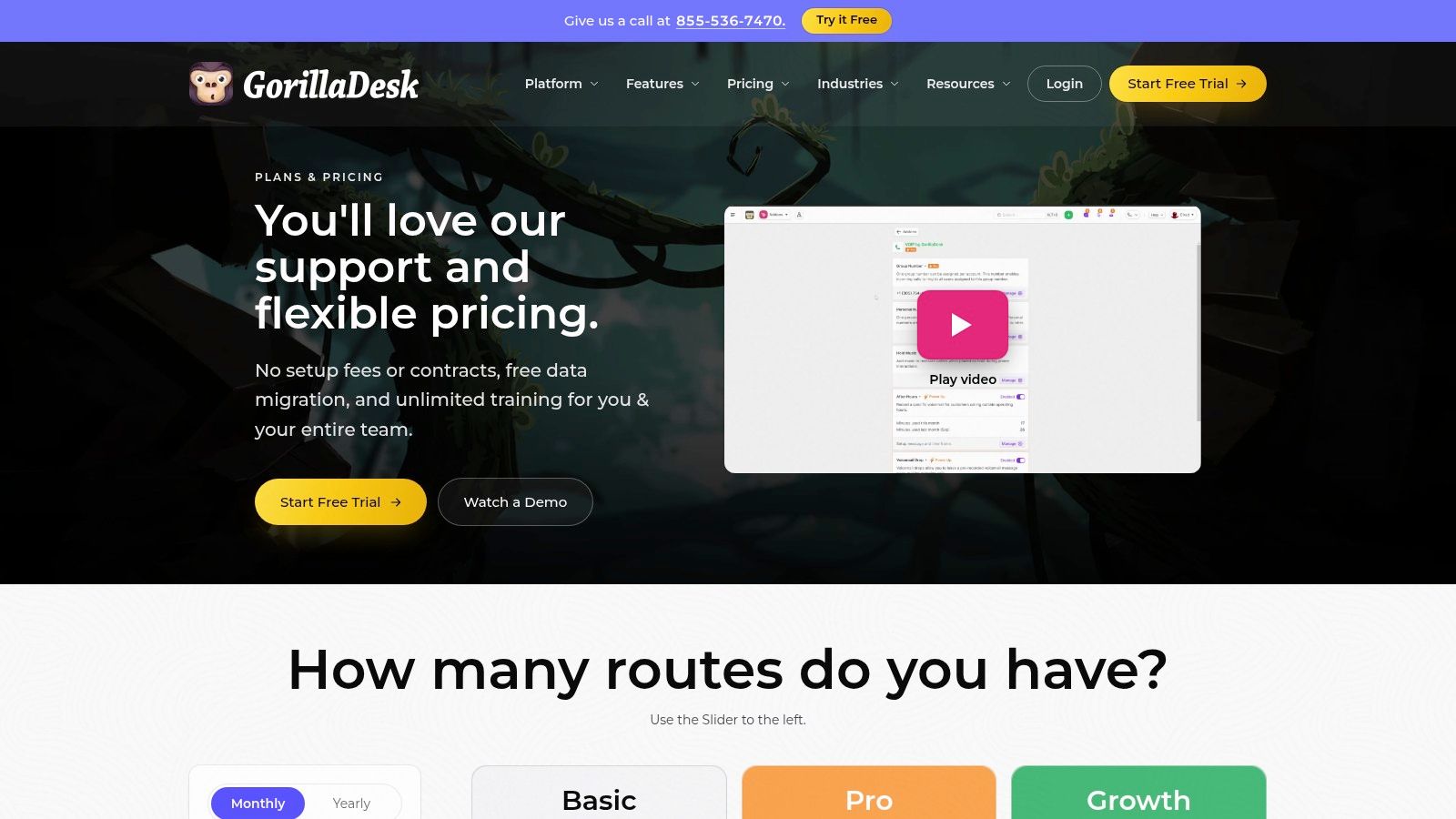
GorillaDesk advertises a 14-day free trial and month-to-month use, which gives an owner-operator a way to evaluate the product without beginning with a long-term commitment. It also lists Stripe and Square connectivity. Subscription prices do not establish payment-processing rates or any platform surcharge, so buyers should request those charges in writing before comparing total payment costs.
The route-based structure has a practical budgeting implication: adding office users may not raise the bill through additional user seats, while adding service routes can affect costs. Route count is therefore a better starting point for estimating spend than headcount alone. An annual Basic price of $539, or about $44.92 per month, appears in ProToolHQ's comparison, but it is not a price published by GorillaDesk and should not be treated as one. Verify the vendor's current plan terms before signing.
PestPac Plans, Sales-Quote Pricing, and Feature Scope
PestPac's vendor page names Small Business, Professional, and Enterprise, but its pricing page publishes no dollar figure. Prospective buyers are directed to a sales consultation, so a company can't calculate its subscription from the plan names alone. WorkWave's PestPac pricing information is the vendor source for its published plan structure and quote-led buying process.
Independent software listings report a broad set of PestPac functions, including scheduling, dispatch, route optimization, mobile access, customer history, pesticide-usage tracking, pest-activity tracking, barcode and ticket scanning, property layouts, real-time reporting, electronic payments, technician management, and customizable reports. These reported capabilities may matter for businesses that need to connect service visits with chemical records, inspection evidence, and property-level history. The listings describe feature scope, not a substitute for confirming what a specific quote includes. Software Advice's PestPac profile outlines capabilities reported for the product.
PestPac's breadth may be more relevant to termite and commercial work than to a small residential route with a simpler record-keeping burden. A company serving properties with detailed documentation requirements should test whether the platform can capture the exact evidence its customers or regulators require, rather than assuming a feature label covers every workflow.
A feature list describes possibilities. A written quote describes what the buyer is actually purchasing.
Industry reporting characterizes PestPac pricing as custom-quoted and module-based. That means the buyer needs to separate the named plan from the modules, services, and terms included in the offered package. Monthly estimates published by directories or review sites aren't vendor quotes and shouldn't be used as confirmed prices. Before comparing PestPac with a public route-based plan, request a written breakdown of seats, modules, onboarding, contract duration, and payment terms.
Feature Matrix for Scheduling, Routing, CRM, and Compliance
The feature comparison is useful only when it distinguishes what the vendor publishes from what third-party listings report. GorillaDesk's public plan information gives a clearer view of its scheduling and billing scope. PestPac's broader reported feature set points toward more specialized operational controls, but the exact package should be verified in a quote and demo.
| Capability | GorillaDesk | PestPac |
|---|---|---|
| Scheduling | Scheduling is included in the published Basic plan. | Scheduling is reported by independent software listings. |
| Dispatch | Basic routing is included, with a published limit of up to 25 stops. | Dispatch is reported by independent software listings. |
| Route optimization | Pro adds route optimization, according to the vendor's pricing page. | Route optimization is reported by independent listings; confirm its availability in the quoted package. |
| Quoting and estimating | The cited vendor plan details don't establish a specific quoting or estimating feature scope. | The cited independent listing doesn't establish a specific quoting or estimating scope. |
| Invoicing | Invoicing is included in the published Basic plan. | Electronic payments are reported; confirm invoicing scope and included modules with the vendor. |
| CRM and customer history | Customer records and a customer portal are part of the described product scope; Pro adds the portal. | Customer history and property-level information are reported by independent listings. |
| Mobile access | Mobile devices are described as unlimited in the route-based model. | Mobile access is reported by independent software listings. |
| Payments | Stripe and Square connectivity are advertised; confirm processing costs directly with the vendor. | Electronic payments are reported by independent listings; confirm available options and fees in writing. |
| Chemical and compliance records | Material tracking is included in Basic. Confirm the exact chemical and compliance fields needed for the business. | Pesticide-usage tracking, pest-activity tracking, inspection evidence, and property layouts are reported by independent listings. |
The table doesn't establish that one product is stronger in every workflow. GorillaDesk's public pricing and plan descriptions make its entry-level scheduling, invoicing, and basic routing easier to assess. PestPac's reported tracking and documentation capabilities make it the more relevant candidate when chemical records, inspections, and multi-location oversight shape daily operations.
PestPac's reported strengths point toward regulated chemical documentation and commercial work. GorillaDesk's public buying model fits the owner-operator who needs a known starting cost and a practical route workflow.
Migration, Implementation, and What to Get in Writing
A free migration offer can sound thorough while covering only a defined set of fields. GorillaDesk's migration description covers contact information, service and billing addresses, notes, and starting balances, but not full past service or billing history. ProToolHQ's GorillaDesk and PestPac comparison describes that migration scope. Because the information is from a third-party comparison, the buyer should confirm the exact current scope directly with GorillaDesk before signing.
That distinction matters if a company relies on old treatment records, invoices, service notes, or previous billing details. Customer master data and opening balances may move while historical records remain outside the import. The operator may need a separate export, a retained archive, or a written agreement about what the vendor will transfer.
Put the migration scope on paper
Before committing to either product, ask for a field-by-field list of what transfers and what doesn't. The same request should cover attachments, service histories, billing records, and any data that staff need to find quickly after launch.
The buyer should also ask for an implementation timeline, any onboarding fees, and a clear explanation of who handles each setup task. For PestPac, the quote should identify modules and services included, rather than leaving the buyer to infer implementation costs from a plan name. For GorillaDesk, the migration offer should be checked against the company's actual historical-data needs.
Cancellation terms deserve the same attention. Ask what data can be exported, in which format, and whether access or export support changes after cancellation. A software migration isn't complete if the business can import only current customer details but can't retain the records it needs for ongoing service or future audits.
Demo Questions for Each Vendor
A useful demo should follow the work the company performs, not just the vendor's presentation. The questions below focus on the details that can change the cost or make a feature useful in daily pest-control operations.
Ask GorillaDesk about route capacity and payment costs
- Clarify the 25-stop limit. Does it apply per day, per route, or per dispatch view, and what happens when a route exceeds it?
- Test route optimization against real work. Can it account for service duration, recurring appointments, technician skills, and traffic?
- Review recurring billing. How does subscription billing handle skipped visits, service changes, and schedule adjustments?
- Check the accounting connection. What are the limits of QuickBooks Online synchronization, and which records sync?
- Get processing rates in writing. What do Stripe and Square charge, and does GorillaDesk add any platform surcharge?
- Confirm cancellation and data access. What can the business export if it stops using the product?
Ask PestPac for a complete quote
- List every included module. Which features are included in the quoted plan, and which cost extra?
- Clarify minimums. Are there minimum user or location requirements?
- Verify route optimization. Is it available in the quoted package, and what configuration is included?
- Test the compliance workflow. Can the team configure the chemical and inspection fields its accounts require?
- Itemize implementation. Which onboarding and setup fees apply, and what work does the vendor perform?
- Put the terms in writing. Confirm contract duration, renewal details, cancellation terms, and data export rights.
The point of the call is to leave with comparable commitments, not a collection of feature names. A written quote and a documented route test make it easier to compare what each vendor will deliver.
Which Vendor Fits a Small Pest Route
For a small pest route, GorillaDesk is the more practical starting fit when the main need is scheduling, invoicing, basic routing, and customer records without an extended purchasing process. Its public route-based pricing gives the owner a known starting point, and the vendor advertises a trial and month-to-month use. The published Basic scope covers core operational tasks, while Pro adds route optimization and other features that may matter as the workflow becomes more involved.
That recommendation rests on fit, not on a claim that GorillaDesk has every capability a pest business could need. A buyer should validate the route limit, payment-processing charges, and migration scope before treating the published subscription price as the full operating cost. If the business depends on detailed chemical and compliance records, the feature checklist and demo should establish whether GorillaDesk's specific fields meet that need.
PestPac is the stronger technical candidate for an operation whose work depends on chemical-use tracking, inspection evidence, property-level history, termite or commercial-service documentation, and visibility across multiple locations. Its quote-led model may be justified when the business needs that operational depth and the written package covers the necessary modules. The deciding factor is whether those workflows are central to the company's service obligations or merely features that might be useful someday.

Make the quote part of the comparison
A small operator should start with GorillaDesk if predictable costs and a direct path to evaluating core route software outweigh deeper commercial controls. A regulated commercial or termite operation should give PestPac serious consideration when its documentation and location-management needs justify a sales-led purchase.
Before choosing PestPac, require a written quote that identifies included modules, seats, locations, onboarding, contract duration, payment terms, and cancellation conditions. For GorillaDesk, confirm the route capacity, processing costs, and migration scope in writing. When one vendor publishes a price and the other doesn't, the comparison isn't complete until the quote itself can be assessed.
Contact GorillaDesk for a route-based plan walkthrough and use its trial to check the scheduling and billing workflow against the company's actual service calendar. If PestPac's compliance and commercial features appear necessary, request an itemized written quote before committing.