An HVAC owner-operator can spend an evening comparing ServiceTitan and FieldEdge, request a quote from each, and still finish without a usable monthly number. The vendor calls may explain features, implementation, and business fit, while the documents leave the subscription total, payment costs, and first-year bill unresolved.
That makes ServiceTitan vs FieldEdge less a feature-count contest than a purchasing exercise. Both vendors sell through a quote process, so a buyer comparing list prices is comparing numbers neither company publishes publicly. The decision turns on what each platform covers, what the implementation requires, and whether the added capability fits the crew.
Two Quotes, No Prices
The owner in this scenario has two quote PDFs open beside a dispatch calendar. One describes a wider operating system for a growing contractor. The other focuses more closely on dispatch, service agreements, billing, and technician workflows. Neither document gives the owner a confirmed subscription total that can be entered into a budget.
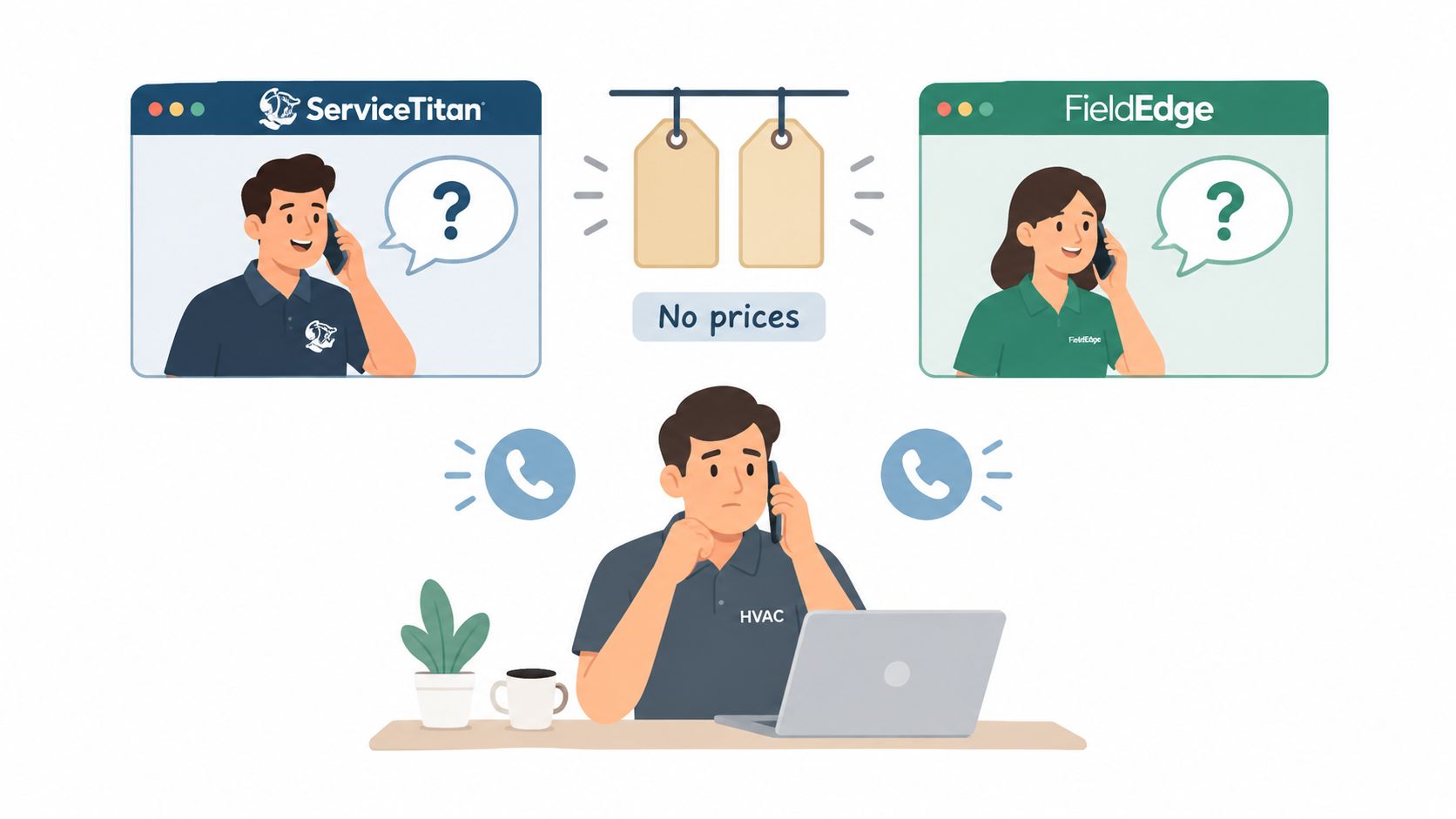
As of October 16, 2026, ServiceTitan's pricing page publishes no dollar figure. FieldEdge's pricing page also publishes no dollar figure. The result is simple: any monthly amount in a buyer's proposal comes from a sales quote, not from a public rate card.
That absence matters most for a one-to-twenty-person HVAC company. A quote can look affordable until implementation, training, payment processing, minimum seats, communications tools, and data migration appear as separate charges. Conversely, a broader platform can be reasonable for a larger shop if the business uses its reporting, integrations, financing tools, and marketing controls.
Practical rule: A vendor quote isn't a first-year budget until it itemizes recurring software, implementation, training, payments, add-ons, minimum commitments, and cancellation terms.
The comparison below avoids market-share claims and third-party forecasts. ServiceTitan's SEC filings provide primary evidence about its corporate scale, while FieldEdge's operational fit must be checked through vendor documentation and written contract terms. Independent review data is used only as a soft signal about setup, support, and price satisfaction, not as proof of business performance.
The useful questions are therefore practical. Does the quoted package include the HVAC workflows the office already needs? Which records will migrate? How long will the old system remain available? Will a small crew use the advanced tools, or pay for capacity that stays idle?
What Each Vendor Publishes About Itself
ServiceTitan offers unusually detailed corporate disclosure because it became a public company. Its Class A shares began trading on Nasdaq under TTAN on December 12, 2024, after the company offered them at $71 per share. The related SEC filing records approximately $679.0 million raised before offering expenses and reports $614.3 million in fiscal-2024 revenue, compared with $467.7 million in fiscal 2023. The filing also states that the company remained unprofitable on a GAAP basis during the reported period. ServiceTitan's SEC registration filing supplies the primary record for those figures.
That information gives a buyer context about resources and scrutiny. ServiceTitan has the profile of a heavily capitalized, high-growth software vendor serving the trades, with resources that can support product development, sales, and integrations. It doesn't prove that the platform is the right operational fit for a small HVAC company.
FieldEdge doesn't have an equivalent disclosure record in the cited material. No comparable SEC filing, audited revenue series, IPO event, or independently verified customer-growth history is available there. Buyers should therefore avoid treating claims about FieldEdge's market position or growth as settled facts without vendor documentation.
The later SEC filing confirms the timing of ServiceTitan's public-company transition and repeats the fiscal revenue comparison. It also reinforces the distinction between corporate scale and product suitability. A small contractor still needs to examine minimum seats, setup charges, payment terms, data rights, and cancellation provisions.
What the disclosure does not answer
The public filing cannot tell an HVAC owner whether dispatchers will configure the board quickly, whether technicians will use the mobile workflow, or whether the quoted reporting tools match the office's needs. FieldEdge's lack of equivalent public-company reporting creates the opposite problem. It doesn't make the product unsuitable, but it means the buyer must verify more of the commercial relationship directly.
The asymmetry is useful, provided it isn't overstated. ServiceTitan's filings support conclusions about scale and historical financial performance. They don't establish better day-to-day performance for a one-truck or three-truck operation. FieldEdge buyers should demand a written proposal, contract terms, implementation scope, and product demonstration tied to actual HVAC workflows.
Feature Scope Side by Side
An HVAC owner comparing these two systems is usually comparing how far each platform reaches beyond intake, dispatch, field work, invoicing, and payment. ServiceTitan's published materials point to a broader operating stack, while FieldEdge's public pages describe a narrower field-service core.
ServiceTitan describes its broader platform and integrations as including call recording, CSR scripting, marketing attribution, financing integrations, real-time revenue dashboards, and more than 70 integrations, including Sage Intacct, Ferguson, and XOi. FieldEdge's published scope covers dispatch boards, payment processing, service agreements, mobile invoicing, digital estimates that convert to invoices, scheduling, technician dispatch, and mobile technician access. Its payment capability uses Xplor Pay and supports on-site card acceptance through mobile card readers.
| Operational function | ServiceTitan | FieldEdge |
|---|---|---|
| Dispatch | Broader operational controls and reporting around field work | Dispatch-board assignment, scheduling, technician matching by skill and expected location |
| Quoting and pricebook | More extensive proposal, financing, and sales workflow scope | Digital estimates that can convert to invoices, with core pricebook workflows |
| Recurring service plans | Service agreements connected with broader scheduling and billing operations | Service-agreement management with recurring work and billing workflows |
| Routing and technician work | Wider platform scope for larger operational models | Dispatch and technician assignment centered on practical field-service needs |
| Crew communication | Customer and office communication tools within a larger operating stack | Mobile technician access and field updates |
| Invoicing | Field invoicing with wider financial and reporting context | Mobile invoicing and estimate-to-invoice conversion |
| Payments | Payment processing plus financing integrations | Xplor Pay, on-site card acceptance, and payment processing |
| Integrations and reporting | More than 70 integrations and deeper cross-functional reporting scope | Core field-service workflows with accounting and payment connections |
The difference shows up when a business wants dispatch tied to marketing attribution, financing, call handling, procurement, accounting, and revenue reporting. ServiceTitan's public positioning speaks to that wider connection set. FieldEdge's published material stays centered on the operational loop that matters most to a smaller service team, with fewer moving parts to configure.
Independent review data adds a useful, if limited, check. On G2's comparison page, FieldEdge and ServiceTitan receive near-parity in perceived support, with FieldEdge at 8.2 and ServiceTitan at 7.7 on the cited support measure. That reading may matter to buyers who expect help during rollout or day-to-day use, but it does not settle contract terms, implementation quality, or whether the software fits the actual workflow.
Questions for the demo
A buyer should ask the vendor to show the exact package being quoted, not a general product tour.
- Service agreements: Are recurring maintenance plans included, and can renewal dates, equipment records, and billing rules be handled without a separate module?
- Payments: Which card and ACH rates apply, and is field payment hardware included or billed separately?
- Reporting: Are revenue, technician, close-rate, and marketing reports part of the quoted tier?
- Integrations: Are QuickBooks, Sage Intacct, Ferguson, XOi, or other required connections included, limited, or charged as add-ons?
- Technician access: Are mobile users priced separately, and does the quote impose a minimum seat commitment?
- Pricebook: Does the quoted plan include the needed HVAC pricebook tools, estimate approvals, and estimate-to-invoice conversion?
The practical split is clear. ServiceTitan fits a business that wants deeper cross-functional reporting, more integrations, and room for a larger operating model. FieldEdge fits a smaller team that wants dispatch, pricebook, service-agreement, and billing workflows live without buying a wider system than it can support.
First-Year Cost Drivers Without List Prices
A monthly quote does not show what an HVAC owner will spend in year one. The total also includes software subscription, staff time, payment fees, implementation work, and the disruption that comes with switching systems.
Since neither vendor posts a public rate card on its pricing page, the proposal becomes the only price document. That is why itemization matters.
The recurring bill
The first line is the platform subscription. The next line may be a per-technician or per-user charge, a minimum seat commitment, or different access levels for office staff and field employees. The proposal should say which users count, whether inactive users stay billable, and whether adding a technician changes the contract right away or at renewal.
Payment processing can change the total in a material way. Card and ACH rates should appear separately from the software price, along with any hardware charge, payment-platform fee, deposit rule, or reconciliation cost. A quote that says “integrated payments” without the processing schedule leaves a major part of the budget unresolved.
Marketing, communications, financing, advanced reporting, inventory, and pricebook functions may also sit outside the core package. The vendor should name every add-on required for the workflows shown during the sales call.
The first-year project
Implementation and onboarding are separate from recurring software. A small office may need to prepare customer records, clean equipment histories, rebuild pricebooks, map QuickBooks fields, attend training, and reconcile invoices after launch. Those hours have a cost even when the contract does not show them as a fee.
Independent comparisons cited in the available material estimate FieldEdge setup at roughly $500 to $8,000 and ServiceTitan implementation at approximately $5,000 to $50,000 or more. The comparison outlining those ranges presents them as estimates, so a buyer should treat them as planning figures and confirm every line in the written proposal.
Revenue can also be lost during rollout if dispatchers work in two systems, technicians wait for corrected pricebook items, or billing staff delay invoices while accounting mappings are checked. The risk is operational, not abstract. A lower subscription can still produce a higher first-year bill if the implementation requires extensive reconstruction.
The break-even question is not “Which platform is cheaper?” It is “Which capabilities will recover the added first-year cost for this crew?”
That answer depends on crew size and complexity. A shop should ask whether it will actively use advanced reporting, marketing attribution, inventory controls, financing, or a larger integration set. If those tools will not change how the office operates, the added capacity may not justify the project cost.
A usable proposal should list subscription, user charges, implementation, training, payments, hardware, add-ons, minimum commitments, taxes, renewal terms, and cancellation charges. With that itemization in hand, the owner can compare first-year cash outlay instead of guessing from a sales conversation.
Migration Risk and Operational Continuity
Changing field-service systems can interrupt billing even when the software itself works as promised. The difficult part is moving the records that explain what happened at a property, what equipment is installed, which agreement renews next, and which invoice remains open.
Before signing, an HVAC office manager should request a field-level migration map. It should name the records to be imported, identify fields that require manual reconstruction, and state how the vendor will validate the result.
Records that need a specific answer
Customer names and contact details are only the starting point. The migration discussion should cover:
- Property history: Past jobs, equipment records, attachments, notes, and property-level service history.
- Customer status: Inactive customers, duplicate records, custom fields, and archived locations.
- Recurring work: Service agreements, renewal dates, maintenance schedules, deposits, and open invoices.
- Commercial data: Pricebooks, tax rules, discounts, payment records, and QuickBooks mappings.
- Operational files: Photos, signatures, forms, technician notes, and documents linked to completed work.
A vendor may say that data migration is included while leaving the field-level scope open. The buyer should request a sample export from the current system and ask the vendor to map it before the contract is final. The agreement should also define acceptance criteria, such as which records must be present, how duplicates will be handled, and who corrects failed imports.
Third-party comparisons describe implementation timelines of roughly 8 to 16 weeks for ServiceTitan and about 4 to 8 weeks for FieldEdge, with longer schedules when data is complex. The implementation comparison offers planning context, not a guaranteed delivery date. Configuration choices, integrations, record quality, and staff availability can change the timeline.
Continuity after launch
The old system may need to remain available while the office reconciles customers, invoices, deposits, and service plans. The contract should state whether read-only access continues during that period, who performs the reconciliation, and what happens if acceptance criteria aren't met.
Post-cancellation data access deserves equal attention. The buyer should ask who owns the export, which formats are available, whether attachments are included, how long the export remains accessible, and whether the vendor charges for retrieval.
A quote price becomes a first-year price when migration labor, downtime, reconciliation, and data access are written into the project plan.
FieldEdge's recurring ease-of-setup reputation may appeal to a smaller office. ServiceTitan's broader scope may require more configuration and training. Neither general impression replaces a migration map, rollback plan, and written responsibility matrix.
Which Vendor Fits Which Crew
A one-truck HVAC operator and a multi-location contractor do not need the same operating model. The better choice depends on the work the crew performs, who manages it, and the reports the owner uses.
One to three trucks
FieldEdge is the closer fit for a small HVAC, plumbing, or electrical team that wants dispatch, pricebook, service agreements, billing, and mobile technician access in one focused workflow. Its published payment scope includes Xplor Pay and on-site card acceptance through mobile readers, which matters when technicians collect payment at the property.
Pricing is still the open question. FieldEdge's pricing page does not publish a figure, and setup, payment rates, user charges, and add-ons still need written confirmation. For a small team, the advantage is fit: fewer advanced operating layers can mean less configuration for an office with limited administrative capacity.
A growing multi-crew operation
ServiceTitan becomes more relevant when the business needs reporting across dispatch, sales, marketing, finance, and technician performance. Its published scope includes marketing attribution, financing integrations, call recording, CSR scripting, revenue dashboards, and a broad integration ecosystem. Those tools matter more when managers need a shared view of a larger operation than a basic dispatch and billing record.
ServiceTitan's corporate disclosures show a well-capitalized public vendor. That scale does not determine whether a smaller contractor will use the platform well. The owner still needs to know who will administer the system, maintain the pricebook, review dashboards, train staff, and manage future configuration.
The soft signal from reviewers
The G2 comparison cited earlier gave FieldEdge a clearer edge in support sentiment and setup satisfaction, along with stronger small-business and price-satisfaction signals in the review summary. Those are useful signals about how reviewers experienced the products, but they are not proof of fit for any particular office.
The decision should rest on demonstrated workflows and written terms. A buyer should ask:
- Crew fit: What is the minimum seat commitment, and how are office and technician users billed?
- Package scope: Which reporting, pricebook, service-agreement, payment, and integration functions are included?
- First-year cost: What will implementation, training, payment processing, and add-ons cost?
- Continuity: What is the implementation timeline, and can the old system remain available during reconciliation?
- Data ownership: Who supplies the export after cancellation, and are attachments and custom fields included?
- Trade fit: Can the vendor demonstrate a residential HVAC call from intake through dispatch, approval, equipment history, payment, and invoice?
For a small HVAC crew, FieldEdge is the more natural starting point when the priority is core execution and quick adoption. For a larger operation that needs connected reporting, integrations, financing, and marketing controls, ServiceTitan offers the broader scope. The final choice should follow the written quote, the migration plan, and the workflows the crew will use every day, not the length of either vendor's feature page.
Request itemized proposals from ServiceTitan and FieldEdge before scheduling a final demo. Require each vendor to show the same HVAC workflow, disclose every first-year charge, map the records that will migrate, and state the post-cancellation data terms in writing.