The driveway looks like a quick booking until the operator adds loading, the round trip, hose setup, treatment, rinsing, and cleanup. The customer sees clean concrete. The business owner sees a schedule slot that produced less profit than expected.
Knowing how to price a pressure washing job starts with accounting for that whole slot, not just the time spent spraying. A useful estimate connects the site conditions to crew time, direct expenses, overhead, and profit before the contractor presents a customer-facing price.
Why Most Pressure Washing Quotes Underprice the Work
A small driveway can be an expensive job to deliver. The truck still needs loading, the crew still travels, and the equipment still needs cleaning afterward. None of those tasks gets shorter just because the customer has less concrete.
Starting with a square-foot rate copied from a consumer cost guide reverses the estimating process. The contractor chooses revenue before establishing cost, then hopes the job fits. Copying another trade's hourly rate creates the same problem because that business may carry different equipment, staffing, insurance, and travel expenses.
Start with the work, not the rate
A better estimate starts with the actual sequence of work. The operator identifies the cleaning method, predicts the complete job cycle, assigns costs, and only then decides whether to present a square-foot price, an hourly arrangement, or a flat quote.
The important distinction is between costing and selling. Costing determines the business's floor. Selling turns that calculation into a clear offer the customer can accept.
- Define the scope: Identify the surfaces, treatments, access conditions, and exclusions.
- Estimate the complete cycle: Include preparation and closeout, not just cleaning.
- Build the cost: Assign labor, materials, operating expenses, and overhead.
- Set the selling price: Apply the intended profit margin and check the minimum charge.
Key takeaway: Rate-first pricing asks what contractors charge for an area. Cost-first pricing asks what this business must collect to complete this particular job profitably.
A market comparison still has a role. If the calculated price looks difficult to sell, the operator should inspect the assumptions: an inefficient route, unsuitable equipment, underestimated access problems, or overhead spread across too little billable work.
Cutting the price without changing those conditions doesn't make the work cheaper to perform. It leaves the contractor with less money after completing it.
Scope Assessment Before You Touch the Hose
The site survey should produce an executable work plan, not just a measurement. A quote based on photographs alone needs clear assumptions wherever access, drainage, contamination, or surface condition remains uncertain.
Surface type changes the proposed method. Concrete, brick, vinyl, wood, painted metal, and roofing shouldn't disappear into a generic exterior-cleaning description. The operator needs to identify what can be cleaned, what requires testing, and what falls outside the proposed service.
Scope Checklist for a Pressure Washing Site Survey
| Item | What to Record | Why It Changes the Price |
|---|---|---|
| Measured area | Separate measurements for each surface | Establishes the quantity of work |
| Surface condition | Material, coatings, cracks, loose paint, existing damage | Changes testing, protection, and method |
| Contamination | Dust, mildew, oil, rust, gum, or overspray | Determines treatment and possible exclusions |
| Access | Gates, parking, hose route, slope, obstructions | Adds handling and positioning time |
| Height | Elevated surfaces and equipment access | Changes the work plan and safety setup |
| Water supply | Source, availability, and restrictions | Affects equipment and mobilization |
| Protection | Plants, vehicles, windows, outlets, neighboring property | Adds preparation and rinsing |
| Treatment process | Products, application, dwell, agitation, rinse | Changes material consumption and labor |
| Wastewater destination | Drains, collection points, proposed disposal route | Determines recovery requirements |
| Customer constraints | Working hours, tenant access, traffic, requested results | Changes sequencing and scheduling |
Similar area doesn't mean similar work
Consider comparable driveways. One has light surface dirt, open access, and room to position equipment. The other has oil staining, a steep approach, and a narrow side gate that complicates hose handling.
The second driveway needs a different estimate even if its measured area matches the first. Treatment, dwell time, handling, and recovery can change the production plan. Area alone doesn't capture those differences, as the Field Promax pressure-washing pricing guide explains when discussing surface condition, access, and scope adjustments.
Photographs should document existing damage and treatment areas. The written scope should distinguish ordinary cleaning from stain treatment, with no promise that every discoloration will disappear.
Wastewater destination belongs on the survey itself. An unidentified drain isn't a harmless omission. Until the discharge route is understood, the operator can't confidently select the recovery equipment, estimate disposal time, or finalize that portion of the price.
Calculating Production Time and Loaded Labor Cost
Crew hours and labor-hours aren't interchangeable. Elapsed time describes how long the job occupies the crew. Labor-hours describe the combined time consumed by everyone assigned to it.

For example, a two-person crew spending 3 hours on site plus 1 hour loading, traveling, and cleaning up consumes 8 labor-hours; at an illustrative loaded labor cost of $30 per labor-hour, the labor component is $240, before other job costs and profit, as shown in SimplyWise's pressure-washing cost guidance.
That calculation prevents an easy estimating mistake: multiplying the elapsed job duration by a rate intended for an individual worker. The crew consumes everyone's time, including during travel and setup.
Build a loaded rate without counting expenses twice
The technician's wage isn't the business's full labor cost. Payroll taxes, workers' compensation, and other employment costs belong in the labor calculation. An owner-operator also needs an allowance for performing the work rather than treating personal labor as whatever remains afterward.
Vehicle costs, equipment depreciation, and insurance must be recovered somewhere in the model. They can sit in separate operating or overhead categories, but they shouldn't also be buried in a broadly loaded hourly rate and charged again.
- Labor burden: Record wages or owner labor allowance plus applicable employment costs.
- Operating allocation: Decide where vehicle use, equipment wear, and machine fuel belong.
- Overhead allocation: Recover office administration, general insurance, and other shared expenses consistently.
- Cost check: Confirm that each expense appears once, not in overlapping categories.
Use actual production records
Production time can be estimated as measured area divided by the business's observed production rate, followed by allowances for the remaining tasks. There isn't a dependable universal cleaning speed for every machine, surface, and soil condition.
Records should distinguish active cleaning from preparation, treatment, rinsing, recovery, and teardown. Otherwise, a production rate calculated from trigger time will underestimate the next booking.
A solo operator needs the same discipline. Unloading, quoting, collecting payment, and putting equipment away still consume capacity even without employees.
A faster cleaning pass doesn't necessarily produce a shorter booking. Access, treatment, and closeout may remain unchanged.
After each completed job, compare estimated and actual labor time by activity. Repeated differences identify the assumption that needs correcting instead of encouraging an arbitrary increase across every quote.
Square-Foot, Hourly, and Line-Item Pricing Models
The customer-facing model should explain the offer without exposing every internal calculation. A homeowner may prefer a fixed price per surface. A property manager may need separate cleaning, recovery, and disposal items for approval.
Square-foot pricing suits repeatable surfaces when the contractor understands the production conditions. It becomes less dependable when a small measured area still requires substantial mobilization, or when contamination changes the treatment.
Hourly pricing can suit uncertain work, but the agreement needs to define the billing basis. A crew-hour charge and an individual labor-hour charge are different offers. The customer also needs to understand what happens if treatment takes longer than expected.
The Same Job Priced Three Ways
| Model | Internal Cost | Presented Price | Best Use |
|---|---|---|---|
| Square-foot | Labor, materials, operations, and overhead calculated internally | Measured area multiplied by the selling rate, subject to the minimum | Repeatable flatwork with confirmed conditions |
| Hourly | Expected crew cost and job expenses | Agreed hourly billing basis with scope limits | Uncertain contamination or exploratory treatment |
| Line-item flat quote | The same cost build divided into defined tasks | Fixed cleaning price plus specified treatment or recovery items | Residential clarity and commercial scope review |
Published reference bands include approximately $0.08 to $0.50 per square foot and $50 to $160 per hour, but those are broad pricing references, not a substitute for a job-specific estimate; ServicePro's pressure-washing pricing discussion also addresses the effect of wastewater costs on the quote.
Keep the internal checks separate
Each presentation should recover the same underlying cost and intended profit. Changing the label from hourly to square-foot doesn't change what the business spends.
- Square-foot check: Divide the proposed selling price by the measured area.
- Time check: Divide that price by the expected elapsed crew time.
- Scope check: Confirm that treatment, access, and recovery are represented somewhere in the offer.
Usually, the quote should use one primary model rather than presenting competing calculations that confuse the customer. The other models remain internal checks.
A fixed quote also preserves the benefit of better equipment and improved execution. Under an hourly arrangement, finishing faster can reduce revenue unless the billing terms account for the business's equipment and operating costs.
Setting the Minimum Charge, Travel Fee, and Setup Fee
A minimum charge should come from the shortest job the business can profitably deliver, not from embarrassment about charging for a small patio. The relevant cost is the complete booking, including the schedule space it consumes.
The minimum calculation should include loading, travel labor, vehicle use, setup, cleaning, teardown, administration, and the required profit. A published minimum is useful only when it covers the operator's actual delivery model.
Establish a service-area policy
Travel has separate labor and vehicle components. Paying for the truck doesn't pay the person driving it, and recovering driving time doesn't cover vehicle wear.
For an internal vehicle-cost reference, the IRS business standard mileage rate is 72.5 cents per mile for 2026; a 40-mile round trip represents $29 using that benchmark, before labor and other costs, according to the IRS announcement of the 2026 business mileage rate.
The IRS figure is a tax-accounting standard, not a required customer charge. A contractor can instead use documented vehicle costs, provided the method remains consistent.
| Policy | When It Fits | What to Avoid |
|---|---|---|
| Minimum service charge | Small bookings within the normal service area | Treating the minimum as a price for unlimited scope |
| Travel surcharge | Work outside the area covered by standard pricing | Charging again for travel already included |
| Service zones | A business that needs firm routing boundaries | Accepting distant work without checking capacity |
| Special setup item | Lift access, recovery equipment, or unusual preparation | Adding a vague fee with no defined work |
Explain the minimum through the scope
The customer doesn't need a lecture about overhead. The quote can state that the service includes mobilization, equipment setup, cleaning, and closeout.
Bundling a patio, walkway, or other suitable surface can spread shared preparation across more work. The EOS pressure-washing pricing guide discusses minimum-ticket economics and bundled add-ons as alternatives to undercharging isolated small jobs.
Practical rule: A travel or setup charge should recover a documented operational difference, not function as an unexplained penalty.
When distant work doesn't fit the route or schedule, declining it can be the better decision. A surcharge doesn't automatically make an inconvenient booking worthwhile.
Wastewater, Chemicals, and Compliance as Real Line Items
Wastewater handling is paid work. Containment, recovery, transfer, and disposal should appear in the estimate as defined activities, not as an unexplained increase in the cleaning rate.
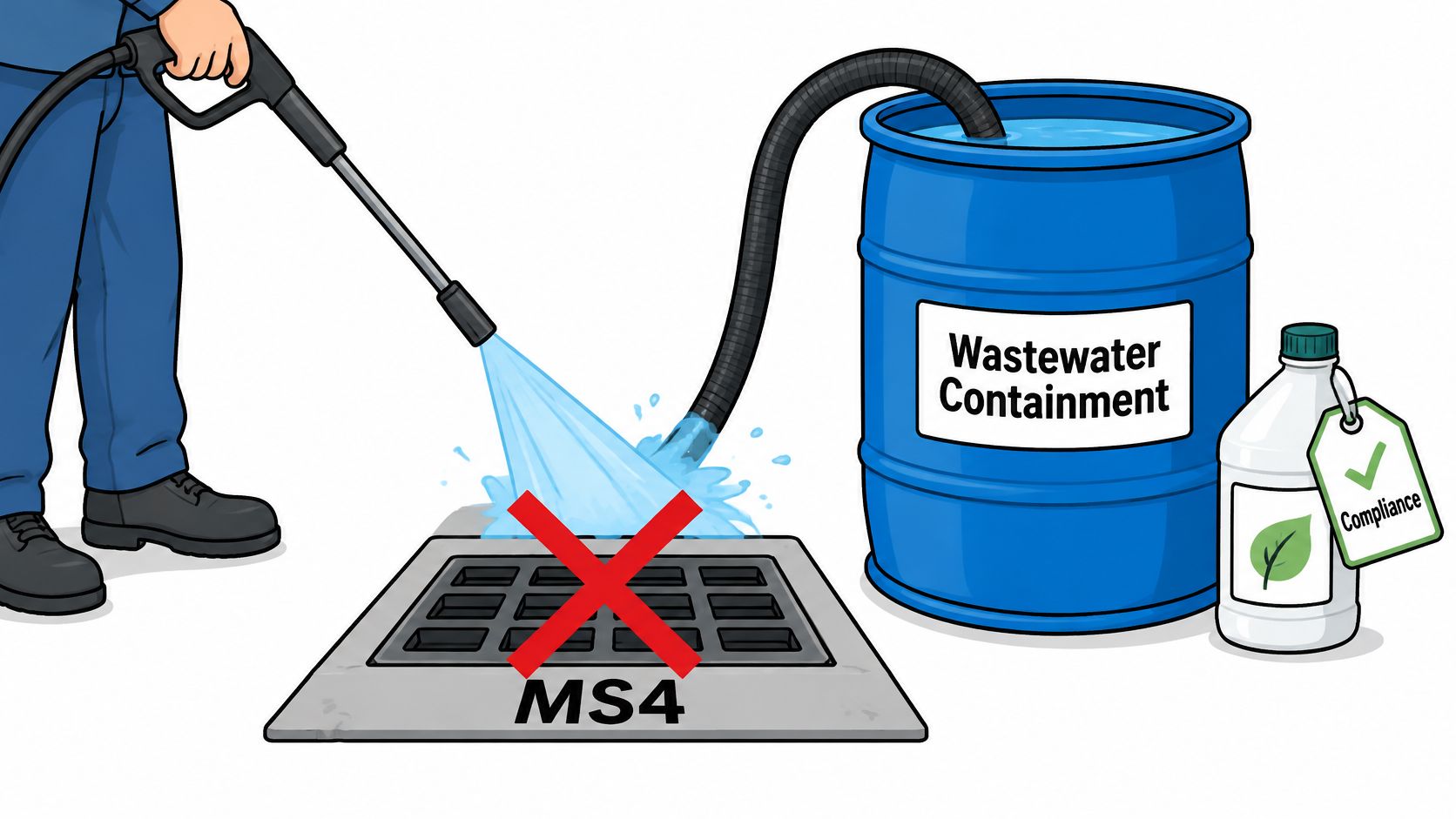
Pressure-washing wastewater generally can't enter an MS4 storm-drain system unless an applicable NPDES permit authorizes the discharge, and the local authority may specify another collection or disposal route, as described in the Cleaner Times guide to environmental concerns.
A nearby storm drain therefore isn't permission to discharge. The operator needs to confirm the destination and applicable local requirements before committing to the recovery plan.
Compliance Items That Belong as Line Items, Not Markup
| Requirement | What It Costs | Quote Line Item |
|---|---|---|
| Chemical treatment | Actual product consumption and application effort | Pretreatment or stain treatment |
| Site protection and PPE | Required protection, consumables, and preparation | Treatment preparation |
| Dwell and rinsing | Crew time beyond the cleaning pass | Chemical application and rinse |
| Containment | Drain covers, berms, placement, and removal | Wastewater containment setup |
| Recovery | Pumps, vacuums, hoses, equipment wear, and crew time | Washwater recovery |
| Disposal | Transfer, transport, receiving fees, and closeout | Approved wastewater disposal |
A compliance allowance should follow the actual plan. The contractor identifies the collection point, estimates recovered volume, confirms an acceptable receiving route, and prices the labor and equipment needed to carry it out.
An ordinary wash and an oily commercial surface may require substantially different arrangements. A universal surcharge can underprice difficult recovery while making straightforward work unnecessarily expensive.
Chemical cost includes more than product
OSHA's Hazard Communication Standard, 29 CFR 1910.1200, applies when employees may be exposed to hazardous chemicals and includes a written program, Safety Data Sheets, compliant labels, and employee training, as summarized in the StartPermit pressure-washing business guide.
Those business-wide obligations usually need an overhead allocation rather than being charged in full to an individual customer. Job-specific mixing, protection, application, and cleanup belong in the particular estimate.
Required PPE and chemical handling should follow the application and Safety Data Sheet, including respiratory protection where exposure warrants it, as addressed in CETA's pressure-washing safety guidance.
The quote should state the intended process and exclusions. Unknown contamination or a newly identified disposal requirement should trigger review before extra work proceeds.
The Pricing Formula, a Worked Example, and Sending the Quote
The estimating formula should keep cost, overhead, and profit distinct. Adding a markup and achieving a target margin aren't the same calculation.
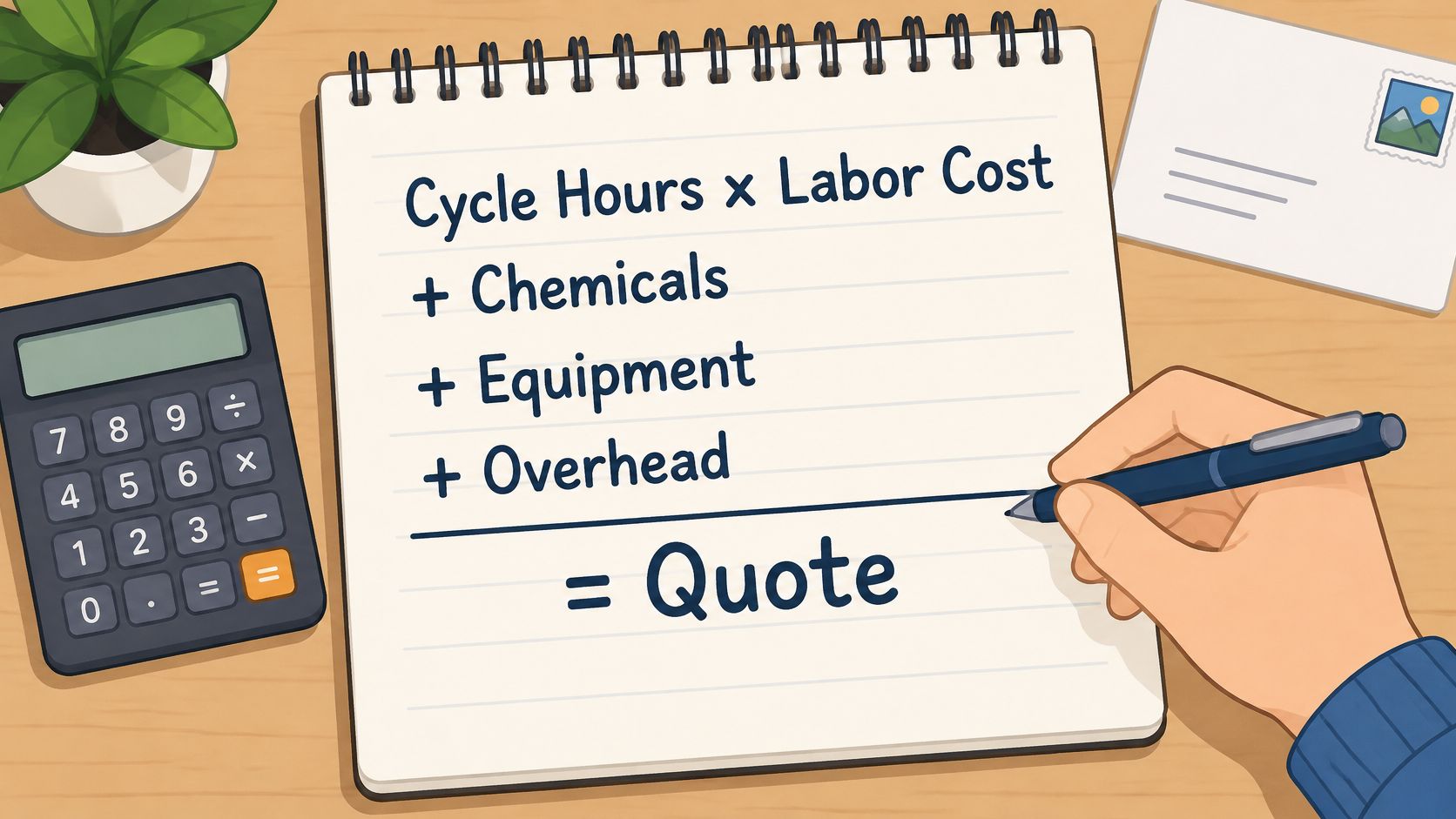
Estimated job cost = total labor-hours × loaded labor rate + chemicals + vehicle and equipment costs + compliance and disposal + allocated overhead.
Selling price = estimated job cost ÷ the share of revenue remaining after the target profit margin.
A spreadsheet calculator that stays useful
A practical worksheet needs separate input cells instead of a single guessed rate. The following layout can handle a driveway with mild organic growth without inventing supplier costs or assuming that recovery is unnecessary.
| Calculator Input | Entry for the Driveway |
|---|---|
| Scope | Measured concrete area and documented condition |
| Labor | Expected total labor-hours multiplied by the business's loaded rate |
| Chemicals | Planned product quantity multiplied by actual unit cost |
| Vehicle | Documented mileage method or allocated vehicle expense |
| Equipment | Expected use multiplied by the equipment-cost allowance |
| Compliance | Confirmed containment, recovery, and disposal requirements |
| Overhead | Consistent allocation of shared business expenses |
| Selling price | Cost adjusted for target margin, then checked against the minimum |
The labor calculation from the earlier crew example supplies only the labor subtotal. It isn't a complete quote until the remaining worksheet fields contain the business's actual costs.
If oil staining is discovered, the estimator revises the treatment and recovery rows. If the customer adds high exterior cleaning, that becomes a separate scope with its own access and protection plan. If a storm-drain restriction changes the disposal route, the compliance estimate changes before acceptance.
Send an offer that matches the calculation
The customer-facing quote should identify each included surface, the cleaning method, treatment allowances, access assumptions, and exclusions. Existing-condition photos and written change-order terms help keep the agreement tied to what was inspected.
For a business already using Jobber, the handoff should preserve that same structure rather than replacing it with a vague cleaning total. The operator should confirm how the account handles line items, photos, customer acceptance, and transfer to invoicing before designing the office workflow around those steps.
A spreadsheet remains sufficient for the calculation itself. Software becomes useful when the office needs to carry the approved scope through scheduling, completion records, and billing without losing details.
Before sending the next quote, the operator should complete the scope checklist, enter actual costs into the worksheet, verify the wastewater route, and compare the result with the business's minimum. Then the quote can be sent with a defined scope and an acceptance step, rather than a price that depends on everything going perfectly.