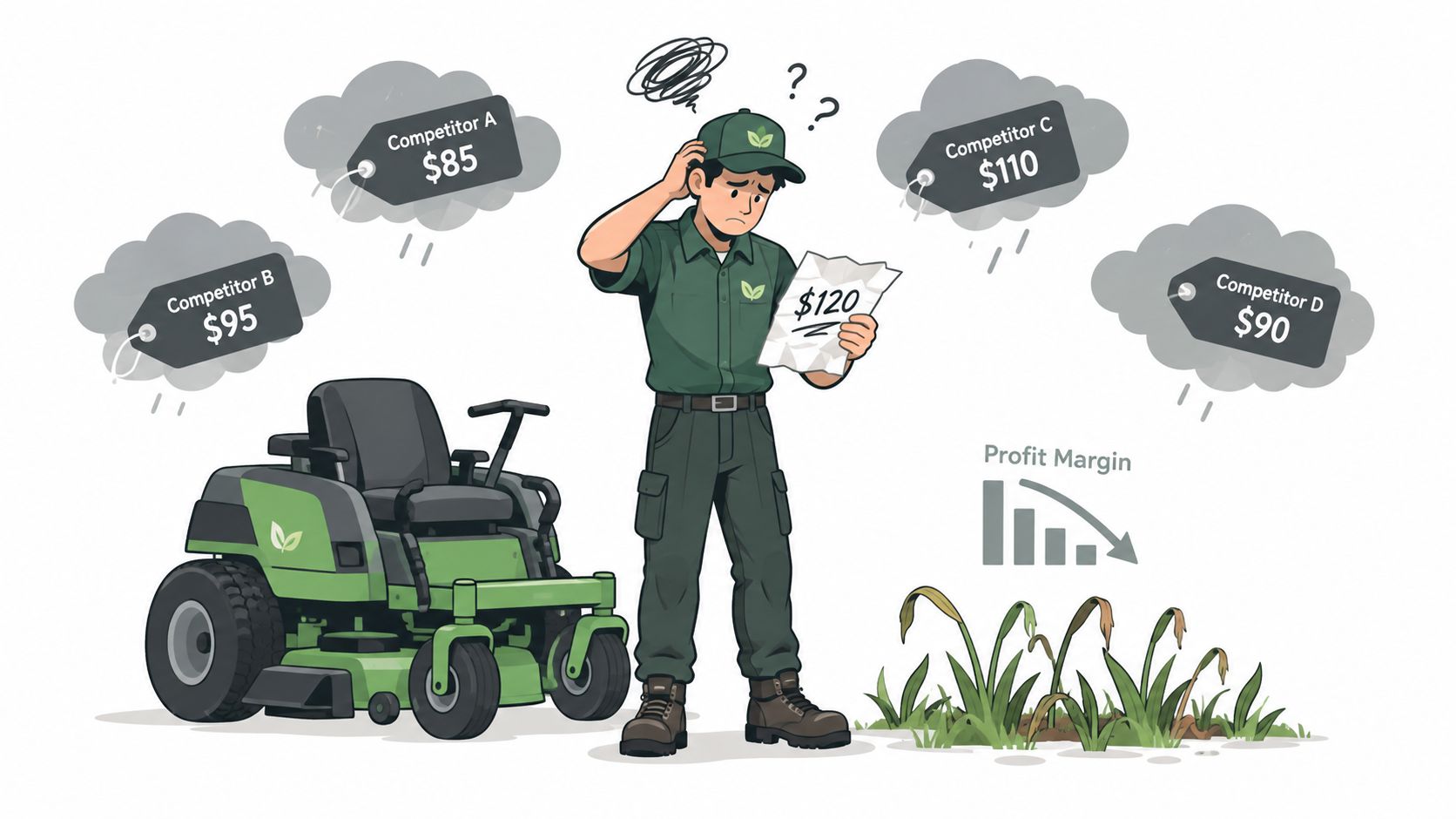
Competitor prices and lawn size alone don't tell an operator whether a mowing stop will make money. A quote that looks reasonable per cut can still lose money once it absorbs crew time on the road, trimming, equipment wear, and cleanup. The useful question isn't just how large the lawn is. It's how much the entire visit costs to deliver, from departure to return.
A sound estimate starts with a labor-cost baseline, then accounts for the property, the route, the service schedule, and what the customer expects. That approach makes it possible to quote consistently without treating a neighbor's price or a square-foot formula as a substitute for job costing.
Moving Beyond Guesswork and Flat Rates
A flat rate can work. A rate based on instinct, a competitor's price, or mowing time alone can leave the operator paying to serve the property. Each stop takes labor before and after the mower runs: loading and unloading, travel, trimming, edging, cleanup, and sometimes clipping disposal.
The U.S. Bureau of Labor Statistics counted 929,930 landscaping and groundskeeping workers in May 2023, with a median wage of $17.96 per hour and a mean of $19.13 per hour (BLS occupational wage data). These employee wages provide a benchmark, not a customer rate. Payroll taxes, insurance, equipment, travel, and office time all affect what it costs to deliver a job.
Price the whole stop
A large property near other customers may be more profitable than a small lawn that requires a long drive. Route density affects how much paid time goes into each completed job. Turf area matters, but it cannot show the full cost of getting the crew to the property and finishing the visit.
For example, price the work from observable requirements: lawn area, mowing frequency, obstacles, edging, blowing, bagging, and expected on-site time. Then account for where the stop sits on the route and how much crew time the entire visit uses. A quote built this way reflects the job being sold, rather than a square-foot guess.
The BLS series shows the occupation's median wage rose from $13.31 per hour in May 2017 to $17.96 in May 2023. Reusing an old estimate without updating labor assumptions can squeeze the margin on a recurring job, even if its scope has not changed.
Practical rule: If the price covers mowing but not the full visit, the operator is accepting an unpriced commitment.
Calculating Fully Burdened Labor and Travel Costs
The wage paid to a crew member is only one part of labor cost. A business also pays payroll taxes and workers' compensation, and it carries the cost of paid time that doesn't produce billable work. Supervision and administration take time too. Adding those expenses produces a fully burdened labor cost, a more useful figure for estimating than the wage alone.
The BLS reported a May 2024 annual mean wage of $40,880 for landscaping and groundskeeping workers, and $59,380 for first-line supervisors in landscaping, lawn service, and groundskeeping (BLS featured wage data). Those are employee wage benchmarks, not billable rates. A contractor needs to use actual payroll data where available, then account separately for payroll burden, supervision, and nonproductive time.
Include vehicle use in the math
Travel can make two otherwise similar jobs very different. The IRS's 2026 business standard mileage rate is 72.5 cents per mile for business use of cars, vans, pickups, and panel trucks (IRS announcement of the 2026 mileage rate). It's a planning benchmark, not a required customer charge or a replacement for a business's own fleet-cost calculation.
For example, 20 business miles represent $14.50 at that rate, before labor, equipment, insurance, or profit. That example makes clear why travel assumptions belong in the estimate. The operator should decide whether vehicle costs are included in the mow price, reflected in a route or access charge, or billed separately. The quote should also make clear which parts of the trip the mileage assumption covers.
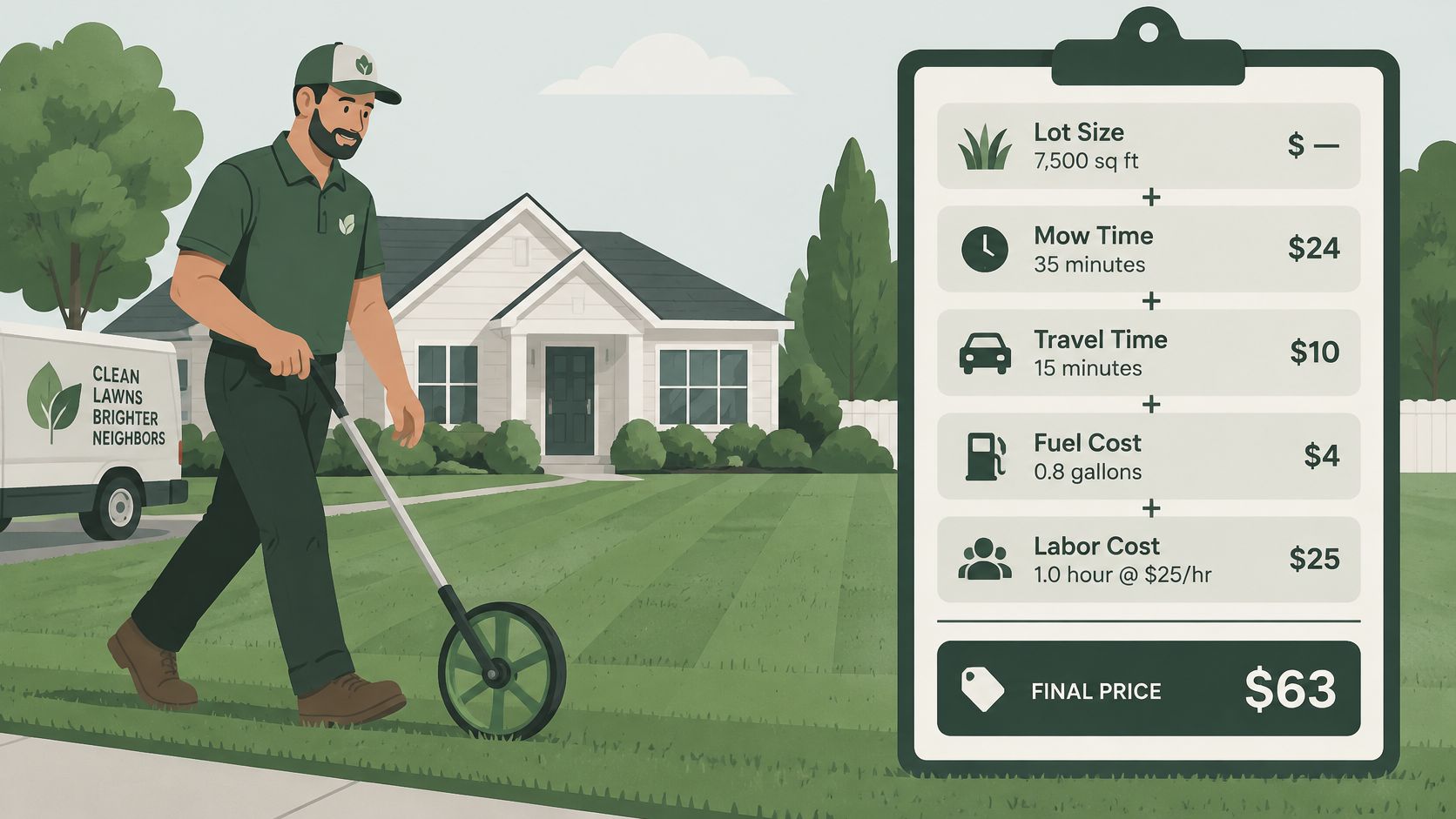
A door-to-door cost calculation accounts for crew time on the route as well as time on the property. One neutral costing example describes a two-person crew paid $18 per hour using about $54 in labor during a 90-minute door-to-door visit, plus roughly $3 to $4 in fuel, before equipment depreciation (lawn-mowing cost calculator example). The useful lesson isn't to copy those example figures. It's to include travel, fuel, and equipment wear rather than counting only minutes spent mowing.
Building the Estimate from Measured Production
A repeatable estimate starts with the work the crew must perform. Measure the mowable area or identify mowable units, then assess slope, obstacles, gates, trimming, edging, clippings, and disposal. Each condition can change the labor required, so the estimate should describe the actual property rather than rely on a generic price per square foot.
Convert scope into a price
Utah State University's turf-management model calculates maintenance labor as task rate × specified units × service frequency, with tasks such as mowing, edging, blowing, fertilization, pruning, and weed control in the maintenance scope (USU landscape-engineering model). A practical estimate can use the same logic:
- Measure the work. Record turf area or another clear unit the business can estimate consistently.
- Classify the property. Note slopes, obstacles, access, gates, and the required trimming, edging, cleanup, or disposal.
- Set task rates. Estimate the labor-hours required per unit for each included task, using the crew's own production records where possible.
- Apply quantity and frequency. Multiply each task rate by the amount of work and the number of scheduled visits.
- Add operating costs. Include travel, setup, fuel, repairs, equipment depreciation, insurance, payroll burden, and overhead.
- Set the final price. Make sure the price covers the required costs and the business's gross-profit target.
A weekly recurring contract over a 30-week season means 30 visits. That's an annual service commitment, even if the customer sees a monthly or per-visit price. State the annual scope and total requirement first, then present the payment format clearly.
Keep the base service separate from add-ons. Mowing, edging, and blowing may be part of the recurring scope, while overgrowth cuts, bagging, leaf removal, weed treatment, hedge work, and green-waste disposal can be listed separately. That gives the customer a clear choice and prevents extra labor from eating into the base price.
Structuring Recurring Agreements and Seasonal Terms
A recurring contract can look profitable on paper and still lose money when labor becomes scarce or the route spreads out. Set terms around the cost of servicing the account across the full season, including the time spent traveling between stops, rather than treating each mow as an isolated sale.
One platform's dataset of more than 2 million completed mowing jobs across more than 2,000 U.S. cities reported an average of $53.59 per mow and $6.38 per 1,000 square feet per mow. It found that 72.9% of services were scheduled biweekly, with average prices ranging from $49.28 in January to $54.66 in August, a 10.9% difference (LawnStarter industry report). Treat those figures as a market reference, not a rate card. Your labor, travel time, and route density determine whether a similar price works for your business.
Make the terms operational
The same dataset describes an active season from March through November, followed by a winter shutdown in December, January, and February. Set the actual service period and payment schedule to fit your local growing season and route. State how rain or wet ground affects the schedule, whether missed visits are rescheduled, and what happens if a delay leaves grass too tall for a standard cut.
Staff availability can also change the cost of keeping a route covered. A 2025 industry report said 51% of lawn care and grounds-maintenance businesses identified staffing as a significant risk, while 61% of maintenance workers reportedly earned $17 to $20 per hour (2025 industry report). A separate survey found 64% of respondents had faced labor challenges or difficulty finding reliable workers. Payroll assumptions from last season may not cover the cost of replacing a crew member or hiring help during a busy stretch.
Put a review date or labor-adjustment clause in the agreement, and state the minimum crew time the price assumes. Spell out how the base service handles edging, blowing, gates, pets, overgrown grass, and weather delays. If accounts sit far apart, include the extra travel in your pricing or prioritize tighter routes. A low per-cut rate can quickly become unworkable when each visit consumes scarce crew hours and adds unpriced drive time.
Standardizing Quotes with Jobber Software
A spreadsheet or written estimate can work, but only if the operator records the same cost categories and scope details each time. Inconsistent estimates make it difficult to compare expected labor with actual labor, and easy to overlook travel or recurring add-ons. Software such as Jobber can be part of a standard quoting workflow, but it can't make an incomplete cost estimate profitable by itself.

Use a consistent quote structure
The operator should enter the same core information for each property: measured area, access notes, mowing frequency, expected crew-hours, travel assumptions, included work, and exclusions. In Jobber or another estimating tool, the service list can be organized so the base mow is distinct from optional tasks such as edging, bagging, or a one-time cleanup. That structure helps customers see what the quoted price covers without bundling uncertain extras into every recurring visit.
A useful quote names the service, frequency, payment basis, and conditions. Instead of a vague “lawn care” line, the estimate can spell out mowing, trimming, edging, and blowing as included tasks, then list disposal or overgrowth work separately. The business should also record why the price changes between properties, such as difficult access or longer route time. That makes future revisions easier to explain.
Digital approval can keep the customer's acceptance and agreed scope together with the estimate. The operator still needs a separate process for reviewing actual labor and vehicle use after service. A quote tool records the plan; job-costing records whether the plan matched the work. If those records aren't compared, software only makes an inaccurate price easier to repeat.
Keep the tool in its place: A quote template standardizes the calculation. The operator still has to measure the work and check the result against actual costs.
Reviewing Route Profitability and Job Costing
The first estimate is a forecast, not proof that the price works. After each visit, record actual crew-hours, route time, fuel, and any work outside the original scope. Compare those figures with the estimate while the details are fresh. If a property repeatedly takes longer than allowed, remeasure it or revise the price at renewal rather than letting the difference accumulate.
Look beyond price per visit
A visit that brings in a strong-looking amount may still return little if the crew spends too long driving or handling access problems. Track revenue per total crew-hour, not only revenue per cut. Total crew-hours account for the labor consumed across the visit, while the comparison can expose stops that look attractive on paper but occupy too much of the route.
Job costing also clarifies whether a shortfall comes from the estimate or from extra work. A customer may repeatedly ask for bagging, cleanup, or trimming beyond the stated scope. A modular quote lets the operator price those tasks separately instead of absorbing them into the recurring mow.
Published landscaping benchmarks commonly put maintenance gross margin around 40 to 55%, with net margin often around 5 to 15% after overhead (landscaping job-costing guide). Gross margin and markup aren't interchangeable: at a 50% gross margin, a job with $28 in fully loaded direct costs needs a $56 price before taxes or separately charged extras. A 50% markup on that cost produces $42, which is a 33.3% gross margin.
Use each renewal to adjust for real labor, fuel, equipment costs, travel, and out-of-scope requests. A reliable lawn-mowing quote is not the lowest number that wins the stop. It's a clear price for a defined service that pays for the crew, the route, and the work the agreement includes.
Before sending the next lawn-mowing estimate, measure the property, write down the door-to-door cost assumptions, and state exactly what the recurring price includes. Then compare the first service visits with the estimate and update the renewal price when the actual work calls for it.