A four-truck HVAC owner in Phoenix has just hired a fifth technician. Group texts are breaking down, the calendar is crowded, and every missed handoff lands on the owner's phone. She puts Jobber and ServiceTitan side by side and assumes one is just the cheaper version of the other.
That assumption leads many contractors into the wrong purchase. Jobber and ServiceTitan are built for different operating models, not merely different budgets. Crew size, dispatch structure, and the amount of administrative control the business needs should decide the shortlist before any feature comparison begins.
Two Different Businesses, Not Two Price Points
Jobber fits the smaller home-service operator who needs a practical system for quoting, scheduling, invoicing, and customer communication. ServiceTitan fits an established contractor with a more formal office operation, structured dispatch, customer service representatives, and a larger technician base. A comparison of the two positions Jobber around solo operators through crews of roughly one to twenty technicians, while ServiceTitan is aimed at contractors with twenty or more technicians and dedicated dispatch or CSR staff. The crew-size comparison also outlines Jobber's published pricing model and ServiceTitan's quote-based sales process.
The distinction matters because software complexity follows the way a company works. An owner who still answers calls, builds estimates, assigns jobs, and checks completed invoices usually benefits from fewer controls and faster administration. A larger contractor may need deeper dispatch rules, detailed job costing, inventory oversight, and reporting that separates the work of dispatchers, CSRs, managers, and technicians.
Practical rule: The wrong software category costs more than the wrong subscription tier.
A small plumbing company can waste money on enterprise features that nobody uses. A larger HVAC operation can waste money on manual workarounds when a lightweight calendar no longer handles technician skills, capacity, and office workflows. Neither problem is solved by choosing the lower price.
Jobber has become a widely adopted SMB platform, serving more than 400,000 home-service professionals across more than 60 countries and processing more than $100 billion in invoiced revenue, according to the comparison cited above. Those figures support a clear point: Jobber isn't a niche product for brand-new businesses. It is a serious option for smaller operators that want a simpler system.
ServiceTitan's advantage appears when the business operates like a coordinated service organization rather than an owner-led shop. The software is designed for more involved dispatching, reporting, inventory, and profitability analysis. The decision isn't “Which product has more features?” It's “Who needs to use those features every day?”
How Each Vendor Positions Itself
Jobber's position is straightforward. It serves small service businesses across trades such as cleaning, landscaping, HVAC, plumbing, electrical, lawn care, pest control, pool service, painting, pressure washing, and handyman work. Its appeal comes from a short path between a customer request and a completed payment. The owner or office manager can keep the main workflow in one place without building an enterprise administration team.
ServiceTitan sits further up the operational ladder. It is aimed at established residential and commercial contractors that need formal dispatch, customer service workflows, detailed operational reporting, and deeper control over technician activity. Independent comparisons consistently describe it as the better fit for larger contractor teams, while describing Jobber as easier to deploy and simpler to administer. The comparison of their operational scope highlights ServiceTitan's advanced dispatching, inventory, reporting, and job-costing strengths.
Vendor positioning at a glance
| Dimension | Jobber | ServiceTitan |
|---|---|---|
| Primary fit | Owner-operators and smaller home-service teams | Established contractors with larger field and office teams |
| Operating style | Simple workflows with a shorter learning curve | Structured dispatch, CSR, reporting, and management workflows |
| Best reason to buy | Quick adoption for quoting, scheduling, invoicing, and customer follow-up | Greater operational depth for complex dispatch and profitability control |
| Pricing approach | Published tiered pricing | Tailored pricing through a sales process |
| Main risk | Reaching the limits of a simple workflow as operations become more complex | Paying for complexity before the business has people to use it |
The go-to-market difference explains the buying experience. Jobber can be evaluated through published subscription information and a comparatively self-directed setup path. ServiceTitan requires a sales conversation because the product is configured around the contractor's operation, technician count, and selected capabilities.
That distinction should shape the evaluation. A contractor looking for a simple monthly subscription shouldn't judge ServiceTitan harshly because it requires a quote. A larger company shouldn't choose Jobber only because its pricing is easier to see. Pricing transparency is useful, but operating fit is more important.
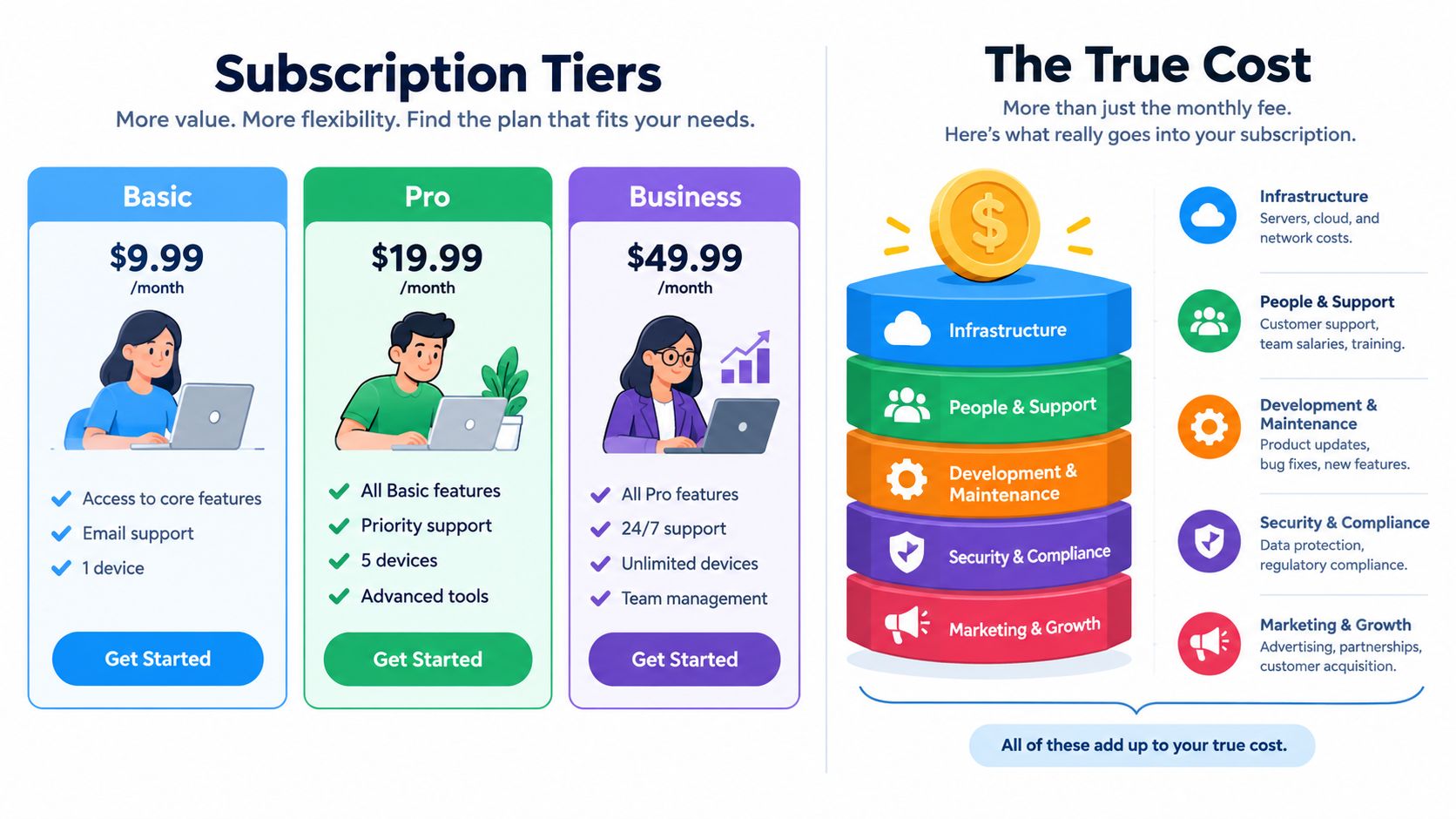
Subscription Tiers and True Cost Components
Jobber publishes tiered subscription information on its official pricing page, which was read on October 3, 2026. The page explains that monthly billing without a commitment can be canceled at any time, with service ending at the close of the current billing period. It also distinguishes that option from a monthly plan with a 12-month minimum term and an annual prepaid plan billed in full at the beginning of the term.
That flexibility gives a small contractor a clearer procurement path. The buyer can forecast subscription costs, understand the billing commitment, and separate the software decision from a sales negotiation. The same page should still be checked for the current tier names, included users, add-ons, and payment terms before signing because those details can change.
ServiceTitan's official pricing page was read on October 3, 2026. It publishes no fixed monthly figure and instead presents pricing as customized for the business, with a per-technician model designed around the contractor's goals and size. A prospect must request a quote.
That isn't automatically a problem. Larger contractors often need a configured package rather than a single public plan. The problem appears when the buyer compares only the base subscription and overlooks the rest of the commercial package. Licensing, implementation, onboarding, selected modules, payment processing, support level, and contract terms all need written treatment.
The cost questions that matter
Before approval, the buyer should request:
- User and technician licensing: Ask whether every office user, dispatcher, CSR, manager, and field technician needs a paid seat.
- Implementation: Request the full implementation charge, the included onboarding work, and any paid training.
- Add-ons: Confirm whether marketing, phones, reporting, payments, inventory, or other modules sit outside the quoted base package.
- Payment processing: Request the applicable processing terms and any platform charges connected to payments.
- Contract term: Ask for the minimum commitment, renewal language, cancellation process, and any early termination costs.
- Data access: Confirm what exports are available if the contractor later leaves.
A public Jobber price is easier to budget, but a visible number doesn't answer whether the selected tier includes the workflow the business needs. A ServiceTitan quote can be appropriate for a complex operation, but the quote must be treated as a complete commercial document, not a starting number from a sales call.
Feature Scope by Job to Be Done
Feature lists make Jobber and ServiceTitan look closer than they are. The better comparison starts with the work that happens between the phone ringing and the invoice being paid.
Jobber is the practical choice when the workflow is mostly linear. A customer requests service, the office sends a quote, the owner or coordinator assigns a technician, the technician completes the job, and the business sends an invoice. The system's lighter administration suits businesses where one person still makes most operating decisions.
ServiceTitan wins when the workflow branches. A call may need to move through a CSR, a dispatcher, a sales process, a technician with a particular skill set, a service agreement, and a profitability review. Independent comparisons describe ServiceTitan as stronger in advanced dispatching, inventory management, reporting, profit-per-hour analysis, and job-costing depth.
Jobber vs ServiceTitan by operational task
| Job to be done | Jobber | ServiceTitan |
|---|---|---|
| Scheduling | Simpler calendar-based scheduling for smaller teams | More advanced dispatching for structured technician allocation |
| Quoting | Straightforward quotes and customer approvals | More involved estimating and sales workflows |
| Invoicing | Practical invoicing and payment collection for routine service work | Deeper financial and operational workflows for larger contractors |
| Recurring work | Suitable for repeat visits and routine service schedules | Better suited to complex service agreements and membership operations |
| Routing | Useful for straightforward crew coordination | Better fit when technician capacity, skills, and dispatch rules matter |
| Reporting | Easier reports for smaller operators | Deeper reporting, job costing, and profitability analysis |
| Inventory | Adequate for businesses with simpler material needs | Stronger fit for contractors managing more involved inventory operations |
The choice depends on whether the added control changes daily decisions. A landscaping company with repeat maintenance visits may not need enterprise dispatch logic. A commercial HVAC contractor with specialized technicians, multiple trucks, and formal service agreements may quickly outgrow a basic calendar.
The best feature is the one that removes a real daily bottleneck. Unused complexity is an expense, not an advantage.
Jobber wins on adoption and administration. ServiceTitan wins on operational depth. Neither advantage is universal. A small electrical contractor that needs estimates, schedules, invoices, and customer messages may find ServiceTitan excessive. A growing plumbing company with a dispatcher, a CSR team, detailed equipment histories, and formal profitability reviews may find Jobber too limited.
Implementation, Migration, and Contract Terms
Implementation should be treated as an operating project, not an account-creation task. The software has to carry customer records, job history, pricing information, accounting connections, payment settings, and user permissions into the new workflow.
Jobber is generally positioned as the lighter deployment. A smaller operator can set up the account, bring in customer and job information, connect accounting or payment tools, and begin configuring quotes and schedules without a large implementation department. That simplicity is valuable when the owner can't take the business offline for a long rollout.
ServiceTitan requires a more formal sales-led onboarding path. The contractor should expect a defined implementation process, configuration work, training, and data migration planning. That structure makes sense for a larger operation, but it also means the buyer must assign internal ownership. Someone needs to approve workflows, validate records, train office staff, and confirm that technicians can complete their work correctly.
What should transfer cleanly
The buyer should ask both vendors to confirm how they will handle:
- Customer records, including contact details and service addresses.
- Job history, including completed work and open jobs.
- Pricebook items, including labor, materials, and standard services.
- Invoices and payments, including how historical balances will appear.
- Accounting connections, including the direction and timing of synchronization.
- Equipment and agreement history, especially for HVAC, plumbing, and electrical businesses.
The most important migration questions concern continuity. Can historical reports still be compared after the move? Can existing phone numbers be transferred? Will QuickBooks or another accounting connection send data in both directions, or only one? What happens to customer and job records after cancellation?
A clean order form matters just as much as a persuasive demo. The contract should show the exact term, renewal language, implementation work, included support, add-ons, payment conditions, and data-export rights. Verbal assurances are too easy to lose once the sales representative is no longer involved.
Which Tool Fits Which Trade and Crew Size
A solo cleaner, painter, pressure washer, or handyman usually needs a short operating loop. The owner receives the request, sends the quote, schedules the work, completes the service, and collects payment. Jobber is the clear recommendation for that profile because the business needs coordination without a separate dispatch department.
A small landscaping or lawn-care company has a similar pattern, even when repeat visits are important. The central need is reliable scheduling, customer communication, invoicing, and route awareness. Jobber's simpler administration fits better than a system designed around several office roles.
The decision becomes less obvious as a crew grows. A three-to-five-person HVAC or plumbing company can still use Jobber if the owner remains closely involved in dispatch and the work is relatively straightforward. ServiceTitan becomes more compelling when the company adds a dedicated dispatcher, a CSR function, complex technician assignments, detailed reporting requirements, or recurring service agreements that need formal management.
The crew-size call
| Business profile | Stronger fit | Reason |
|---|---|---|
| Solo operator | Jobber | The owner controls quoting, scheduling, and billing |
| Small residential crew | Jobber | The team benefits from a simpler workflow and faster adoption |
| Growing crew with owner-led dispatch | Usually Jobber | The business may not need enterprise operational controls yet |
| Larger contractor with dedicated dispatch | ServiceTitan | Dispatch, reporting, and technician coordination carry more weight |
| Multi-truck operation with structured office roles | ServiceTitan | The software aligns with formal operational management |
| Complex HVAC, plumbing, or electrical service operation | ServiceTitan | Job costing, inventory, and deeper reporting become more important |
Jobber is especially suitable for cleaning, landscaping, lawn care, pressure washing, pool service, painting, and smaller residential trades. ServiceTitan is better aligned with commercial-leaning HVAC, plumbing, and electrical companies that manage multiple field teams and recurring service relationships.
The overlap zone deserves a direct answer. A company with roughly ten to twenty technicians should ask whether the owner still runs dispatch. If yes, Jobber may remain the more sensible choice. If a dispatcher, CSR, and management team already run the office, ServiceTitan deserves serious consideration.
Questions to Bring to the Demo
A demo should not be allowed to stay on the vendor's preferred script. The buyer needs questions that expose the total commitment, the actual workflow, and the limits of the data handoff.
Total cost
Ask: “What will the business pay for every required user, technician, module, implementation service, payment feature, and support level?”
A good answer includes a written breakdown with no unexplained line items. A red flag is a low base quote followed by “that can be added later” for functions the team already expects to use.
Ask: “What is the minimum contract term, how does renewal work, and what happens after cancellation?”
The answer should identify dates, notice requirements, and post-termination access. “The account team can explain that later” isn't enough.
Feature fit
Ask the vendor to demonstrate a normal day for the actual crew. The demo should show a new booking, a reschedule, a quote approval, a completed job, an invoice, and a recurring visit. For ServiceTitan, the buyer should also ask how the dispatch board handles the company's real technician roles, skills, zones, and availability.
A good answer uses the buyer's workflow. A red flag is a feature tour that never shows how the office handles a typical job from first call to payment.
Data ownership
Ask: “What data can be exported, in what format, and how much historical information can be migrated?”
The answer should name customer records, job history, invoices, pricebook items, and equipment information. A vague promise to “help with migration” leaves too much unresolved.
Support reality
Ask who handles onboarding, how many training hours are included, how support is reached, and whether a named account contact is part of the package.
The buyer should record the demo where legally permitted or take detailed written notes. Every material promise should appear in the proposal or contract. A verbal commitment rarely survives a contract that says something else.

The Decision That Actually Matters
The deciding factor in Jobber vs ServiceTitan is the company's crew size and dispatch structure, not the length of either feature list.
Jobber is the recommendation for solo operators and smaller crews, especially residential and light-commercial businesses that need quoting, scheduling, invoicing, customer communication, and basic route coordination without a dedicated dispatcher. Its published subscription structure and lighter administration make it practical for businesses that want the owner or office manager to stay close to daily work.
ServiceTitan is the recommendation for contractors with roughly twenty or more technicians, multiple trucks, dedicated dispatch or CSR staff, and enough operational complexity to use deeper reporting, inventory, job-costing, and dispatch controls. The quote-based buying process makes sense only when the business needs a configured platform and has people available to manage it.
The overlap is real at roughly ten to twenty technicians. The owner-led business should start with Jobber. The business that has already delegated dispatch and built a formal office operation should evaluate ServiceTitan.

Before any demo, the owner should answer one question: Who will use the dispatch board every day, and is that person the owner or someone else? If the answer is the owner, Jobber is usually the better fit. If the answer is a dedicated dispatcher supported by CSRs and managers, ServiceTitan is worth the heavier commitment.
Choose the platform that matches the crew operating today, then request a written quote, implementation plan, data-migration scope, contract term, and cancellation policy before approval. For most small home-service businesses, that means starting with Jobber and moving to a deeper system only when dispatch complexity, office staffing, and reporting needs justify it.