Thryv pricing starts at $99 per month for the Marketing Center Starter plan and reaches $399 per month for the Signature tier. The advertised subscription is only the starting point, because onboarding, usage charges, payment processing, regional terms, and the selected product bundle can change the cost.
A home service owner comparing software often sees the $99 figure while trying to decide whether one platform can handle leads, customer communication, marketing, estimates, invoices, and payments. That number looks manageable for a solo operator. The harder question is whether the quoted plan covers the work the business really needs, and what appears on the invoice after customers begin receiving texts and paying remotely.
Thryv's published pages use more than one pricing structure. The clearest current figures belong to its Marketing Center tiers, while Business Center materials show a different entry point and different plan logic. That distinction matters for pressure washing, cleaning, HVAC, plumbing, landscaping, lawn care, pest control, electrical, handyman, pool, and painting companies because a marketing subscription isn't automatically the same thing as a field-service operating system.
Published Thryv Pricing Tiers and Regional Variations
A contractor comparing software may see $99 per month and assume it covers the whole Thryv platform. The published information supports a narrower conclusion. Thryv presents separate product centers, regional offers, and subscription structures, so the quoted price must be tied to a specific bundle before it can be compared with other field-service tools.
What the published figures represent
Thryv's U.S. pricing page lists Marketing Center Starter at $99 per month and shows higher tiers up to Marketing Center Signature at $399 per month, as described on Thryv's pricing page. The same materials describe a Business Center entry point at $185 per month. These figures apply to different product structures, so the lower Marketing Center price should not be treated as the cost of every operational feature.
That distinction affects home service businesses. Marketing Center Starter and Marketing Center Signature are marketing-focused plans, while Business Center uses a broader business software structure. A contractor evaluating scheduling, estimates, invoices, customer records, and payment collection needs written confirmation of which bundle includes each function before comparing Thryv with Jobber, Housecall Pro, ServiceM8, or Workiz.
Thryv's separate AI and information materials also list Marketing Center Starter at $99 per month and Marketing Center Signature at $399 per month. Amplify is custom priced, so a buyer cannot assess its subscription cost from a published monthly figure. The sales quote, included services, and contract terms become the relevant evidence.
Region changes the contract
Australian terms add costs and commitment rules that a U.S. headline price does not show. Thryv states that the software is sold on an initial six-month subscription period, billed monthly, then renews month to month. It also offers a 5% discount for semi-annual payment and charges a $350 setup fee including GST in the first month, according to Thryv's Australia FAQ.
The result is a regional contract issue, not only a currency issue. U.S. buyers should confirm whether the quote covers Marketing Center, Business Center, or a custom bundle. Buyers elsewhere should verify minimum terms, taxes, setup charges, payment frequency, renewal rules, and any processing fees in the applicable order form.
Procurement rule: Require the order form to name the product center, included services, subscription term, onboarding charge, regional taxes, and payment-processing schedule. A plan name and monthly figure alone do not establish total cost.
Comparing the Starter and Signature Plan Features
The difference between Starter and Signature is not merely the gap between a lower and higher monthly charge. The commercial question is whether a business needs a basic marketing layer or a broader set of customer acquisition and communication tools. Thryv's public pricing materials establish the tier names and prices, but they don't provide enough verified detail here to assign specific user-seat limits, dispatch functions, automation limits, or scheduling capabilities to either tier.
Starter fits a narrower need
Marketing Center Starter at $99 per month is best assessed as an entry marketing subscription, not automatically as a complete field-service management system. A solo cleaner, painter, or pressure washing operator may be considering it for lead handling, customer communication, and marketing activity, but the owner shouldn't assume that the plan includes every operational function needed to run daily jobs.
For a service business, the missing questions are more important than the headline price:
- Scheduling: Does the quoted bundle include appointment booking, calendar management, and customer reminders?
- Estimates and invoices: Can the business create, approve, and send estimates and invoices without another subscription?
- Crew coordination: Does the plan support more than one person working from a shared schedule?
- Payment collection: Is ThryvPay included, and do transaction charges apply separately?
- Marketing scope: Which campaigns, communications, listings, review tools, or website functions are part of the tier?
Those questions should be answered in writing because a low subscription can become expensive if the owner must add another operational product.
Signature needs a business case
Marketing Center Signature at $399 per month is a substantial move up from Starter. It may make sense for a growing company that values a wider marketing package, but the higher tier shouldn't be purchased just because the business has multiple crews. A marketing tier and a dispatch platform solve different problems.
An HVAC or plumbing company should separate marketing requirements from field operations. Advanced customer acquisition tools may help fill the pipeline, while dispatching, technician availability, job history, estimates, invoices, and payment collection determine whether the office can run the work efficiently. Housecall Pro, Jobber, ServiceM8, GorillaDesk, Contractor Foreman, and ServiceTitan should be compared on those operational functions rather than on a marketing plan's name.
The right comparison is therefore functional:
| Business need | Starter question | Signature question |
|---|---|---|
| Lead generation | Which marketing tools are included? | Which additional marketing functions justify the higher tier? |
| Customer communication | What messages are included? | Are broader campaigns or automation included? |
| Field operations | Is scheduling included in this bundle? | Does the tier actually add operational capability, or mainly marketing scope? |
| Cost control | Which add-ons are required? | Does the higher fee reduce separate software or add-on spending? |
A buyer who can't connect the extra subscription to a defined workflow or removed tool is paying for capacity that may not improve daily operations.
Mandatory Add-Ons and Payment Processing Rates
A home service company can accept the advertised subscription and still underestimate its first invoice. Onboarding, message overages, compliance features, and remote card payments all affect the cost of running Thryv for HVAC, plumbing, and landscaping work.
Fees beyond the subscription
Business.com's Thryv pricing review reports a mandatory $250 one-time onboarding fee, a $0.01 charge for each SMS above the included limit, and a $29 monthly HIPAA compliance add-on. It also lists historical Business Center prices of $228 per month for Plus, $382 per month for Professional, and $533 per month for Unlimited.
Those historical figures should not substitute for a current quote because Thryv's pricing structure has changed. They do establish the procurement question: what will the first invoice contain, and which recurring options will remain active after setup? A buyer should request that breakdown instead of multiplying the public subscription price by twelve.
Processing rates change the operating cost
ThryvPay processing starts at 2.6% + $0.30 per transaction, according to the same Thryv pricing materials cited above. Independent coverage reports 2.9% + $0.30 for card-not-present or online payments, as detailed in Business.com's Thryv review.
The rate category matters for field-service workflows. An HVAC company collecting a deposit through an online invoice, a landscaper billing recurring work remotely, and a plumber charging a card on file may all process payments differently. A company taking payment in person can therefore have a different effective processing cost from one sending nearly every invoice by text or email.
| Fee Type | Cost or Rate | Applies To |
|---|---|---|
| Onboarding | $250 one time | Reported mandatory setup charge |
| SMS overage | $0.01 per SMS | Messages above the included limit |
| HIPAA add-on | $29 per month | Businesses requiring that compliance option |
| ThryvPay processing | 2.6% + $0.30 | Reported starting transaction rate |
| Card-not-present processing | 2.9% + $0.30 | Online or remote card payments |
Budgeting rule: Model the quote against message volume, remote payment volume, and required compliance options. The subscription price alone does not show the business's monthly cash outflow.
Contract Terms and Cancellation Windows
A low monthly price does not determine the cost of leaving. Before signing, a small business owner should record four dates: the purchase date, the notice deadline, the subscription end date, and the renewal point.
The refund window is short
Thryv's terms provide a three-day full-refund window after purchase, as stated in the Thryv terms and conditions. After that window, the customer must give notice at least 30 days before the next subscription period begins. The cancellation then takes effect at the end of that subscription period.
The timing can extend the final payment cycle. If an owner submits notice after the deadline, the account may remain billable through the following period. A phone call alone also creates weak evidence. The safer approach is written notice, saved delivery records, and confirmation of both the service end date and final invoice.
Regional renewal rules differ
The Australian FAQ describes an initial six-month subscription billed monthly in advance, followed by automatic month-to-month renewal unless the customer terminates. It also lists a $350 setup fee including GST in the first month, as noted earlier in Thryv's FAQ.
That structure should not be applied automatically to a U.S. purchase. A U.S. pricing page should not control an Australian agreement either. Regional terms, the order form, and the signed contract determine which renewal and cancellation rules apply. This distinction matters for a home service business because a setup charge or longer initial commitment can change the first-year cost even when the advertised monthly subscription looks comparable.
A safer cancellation process
Before signing, the owner should:
- Mark the purchase date: The three-day refund period starts on that date.
- Record the billing period: Confirm when each subscription period begins and ends.
- Set a notice reminder: Submit cancellation at least 30 days before the next period begins.
- List each service: Ask whether marketing, payments, messaging, website services, or other components require separate cancellation.
- Request written confirmation: Keep the effective termination date and final invoice details.
Contract rule: Cancellation requires calendar management. Calculate the notice date before the subscription starts, then verify the result against the applicable regional terms and order form.
Total Cost of Ownership Examples for Small Crews
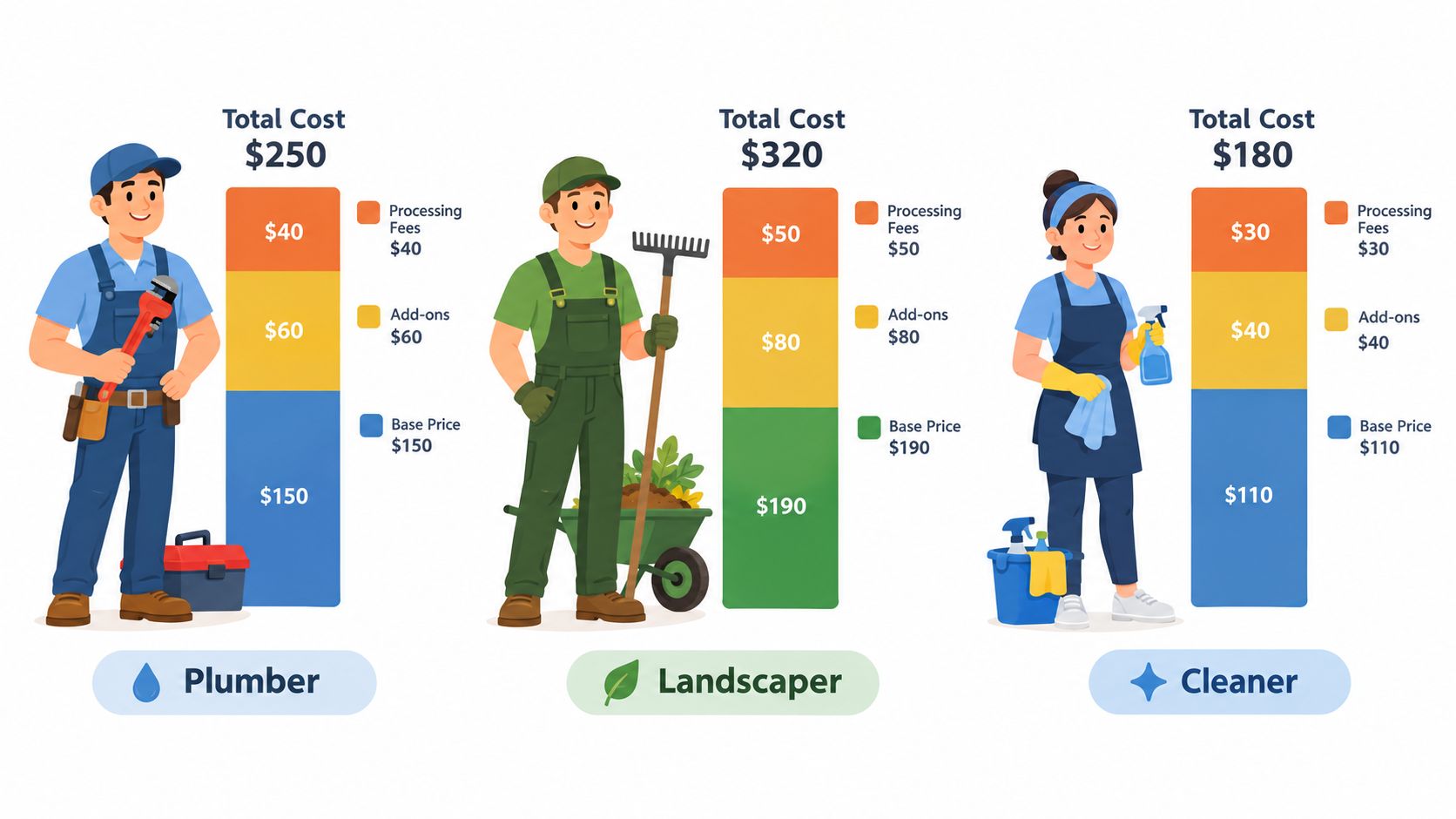
A small home service business should evaluate Thryv pricing from the first invoice through recurring usage. The examples below use published figures and reported charges to show how subscription, implementation, and payment activity can produce different total costs.
A solo operator
A solo pressure washing operator choosing Marketing Center Starter would begin with the $99 per month U.S. entry price cited earlier. That recurring charge is only the baseline. The first invoice may also include the reported $250 onboarding fee, while SMS overages and payment processing vary with customer activity.
The owner should separate the budget into three categories:
- Fixed subscription: The recurring Starter charge.
- Implementation cost: The one-time onboarding amount stated in the quote.
- Variable usage: SMS overages and ThryvPay charges created by customer transactions.
A solo operator who accepts few remote payments may keep variable costs low. Frequent appointment reminders, online deposits, and card-not-present collections create a higher cost profile under the same subscription. The advertised monthly price therefore cannot serve as the complete operating budget.
A three-person HVAC crew
A three-person HVAC company may consider the $399 per month Signature tier, but headcount alone does not establish that Signature is the right purchase. The owner must verify whether the quote covers the office and field functions required, or whether it depends on a separate Business Center structure, add-on, or implementation package.
For a crew handling emergency calls, maintenance visits, and remote invoice payments, the cost model should include:
- Quoted plan: Confirm whether Signature covers marketing functions only or includes operational tools.
- User access: Check how office staff and field technicians are counted.
- Remote payment mix: Apply the applicable card-not-present rate to online collections.
- Setup and migration: Add onboarding and disclosed data-transfer costs.
- Exit exposure: Include any remaining commitment when comparing another platform.
The key procurement finding is that crew size affects usage costs and feature requirements more than the headline tier. A smaller company with frequent online collections can incur more variable expense than a larger business that primarily accepts payments in person. The owner should compare the first-year total, not just the subscription line.
Questions to Confirm Current Terms on a Sales Call
A sales call should end with a written commercial summary, not just a demonstration. Published figures establish useful reference points, but the final quote may depend on product bundle, region, payment services, onboarding, and any custom work attached to the account.
Questions about the product
The buyer should ask the representative to identify the exact product and tier in the proposal.
- Which product is quoted: Is the offer Marketing Center Starter, Marketing Center Signature, Business Center, Amplify, or a combination?
- What does the plan operate: Does it include scheduling, estimates, invoices, customer records, payments, messaging, and marketing, or only selected functions?
- How many users are included: Are office staff, technicians, owners, and contractors counted separately?
- What requires another charge: Are website, messaging, reputation, payment, compliance, or support services separate line items?
- What happens to the website and data: Can the business export customer records, job history, content, and payment records if it leaves?
Questions about money
The representative should provide the first invoice and a recurring invoice example.
Ask for the one-time onboarding charge, any migration or setup work, SMS inclusion and overage rate, payment-processing rates for in-person and card-not-present transactions, and every recurring add-on. The buyer should also ask whether taxes are included and whether annual or semi-annual payment changes the total amount due.
Thryv's Australian materials identify a 5% semi-annual payment discount and a $350 setup fee including GST, while U.S. materials and historical Business Center coverage show different structures. Those regional differences make it unsafe to transfer a term from one market to another.
Questions about commitment
The contract questions should be answered before payment:
- What is the initial commitment?
- When does the subscription renew?
- What date must cancellation notice reach Thryv?
- When does cancellation become effective?
- Does each product or add-on require separate cancellation?
- What charges continue after notice is submitted?
The buyer should request these answers in the order form or a written email from an authorized representative. Verbal assurances are difficult to use when the first invoice or final bill differs from the sales conversation.
Final check: The quote should show the plan, term, onboarding, included usage, overage rules, processing rates, add-ons, renewal date, and cancellation procedure in one written record.
A home service owner considering Thryv should request a written quote that separates the subscription from onboarding, messaging, payment processing, regional taxes, add-ons, and contract obligations. The $99 Starter tier may suit a narrow marketing need, while the $399 Signature tier may fit a business seeking broader marketing capacity, but neither price should be accepted as the complete operating cost until Thryv confirms the exact bundle and exit terms in writing.