
A one-person HVAC business can choose software by looking at features, then discover that the monthly bill depends on something more basic: jobs completed or people using the system. A plumber with an iPhone may value offline access more than a long integrations list, while a mixed-device crew may accept online-only field work to keep every technician on the same platform. That makes the ServiceM8 vs Tradify decision less about which app has the longer checklist and more about how the business operates.
ServiceM8 began in Australia in 2009, with its first product released in 2010 as an iPhone and web application for managing jobs from quotation through completion. Tradify was founded in New Zealand in 2013, so the products came from different trade-software backgrounds and national markets. ServiceM8 and Tradify company information
The Decision Behind ServiceM8 vs Tradify
A growing trade business may have several technicians using the same system while completing a moderate number of jobs. In that situation, billing mechanics can affect the budget before differences in quotes, invoices, scheduling, or customer messages do.
ServiceM8 uses a job-volume model. A paid plan covers a defined number of jobs and allows unlimited users within that band. Tradify uses a per-user model. The business pays for each person who needs access, with no corresponding published job-volume cap.
That distinction matters as staffing changes. Under ServiceM8, adding technicians does not increase the subscription while the business remains within its selected job band. Under Tradify, the total rises when another office or field worker needs access. A fixed-headcount business may prefer that calculation, while a larger crew should examine how user growth affects its recurring cost.
Device policy creates another practical dividing line. Published comparisons describe ServiceM8 as strongest on iPhone and iPad, with field access that can work offline. Tradify supports a wider device range, including Android, Windows, Mac, and Linux, but published help guidance says its centralized job system requires an online connection. Published mobile and workflow comparison

Data portability and administrative automation should shape the decision as well. Before committing, a business should establish whether customer records, property history, recurring jobs, attachments, invoice statuses, and custom fields can be exported in a usable format. It should also check whether automated reminders allow control over approvals, message content, timing, and recovery when a workflow fails.
Practical rule: Compare monthly jobs, active users, device mix, connectivity, export options, and automation controls before weighing feature breadth.
Published Pricing, Plan Limits, and What Each Vendor Publishes
ServiceM8's published structure allocates capacity by monthly job volume. On the ServiceM8 pricing page, read October 12, 2026, the free tier is listed at 30 jobs per month for one user, while Starter is listed at approximately $29 per month for 50 jobs and Growing at approximately $79 per month for 150 jobs. The same published bands include Premium at 500 jobs and Premium Plus at 1,500 jobs, with unlimited users on paid plans.
Those limits describe the unit being purchased. The business isn't primarily buying seats, it's buying room for a certain number of jobs during the billing period. A quiet solo operator may value that structure, while a busy team needs to watch the job band closely and confirm what happens after the cap is reached.
Tradify publishes a different structure. On the Tradify pricing page, read October 12, 2026, the listed Australian plans are Lite at approximately A$48 per user per month, Pro at A$52 per user per month, and Plus at A$62 per user per month, excluding GST. The public structure doesn't show a corresponding job-volume cap.
How the billing units change the calculation
Consider a business with one owner, one scheduler, and several technicians. Under ServiceM8's paid model, the subscription remains tied to the selected job band rather than the number of users. Under Tradify's model, the business should map every person who needs access, including office staff, technicians, and possibly subcontractors, to a paid seat before accepting the quoted total.
The published prices also need context. ServiceM8's headline figures can appear in different currencies by region, while Tradify's cited public prices are in Australian dollars and exclude GST. Currency conversion, tax treatment, excess-job charges, payment fees, and add-ons can change the final amount.
| Pricing question | ServiceM8 | Tradify |
|---|---|---|
| Main billing unit | Monthly jobs | Users |
| Published entry structure | Free tier and job-volume bands | Lite, Pro, and Plus per user |
| User treatment | Unlimited users on paid plans | Each required user affects the bill |
| Published job cap | Yes, by plan | No corresponding cap published |
| Confirmation needed | Excess-job treatment and regional currency | Seat rules, GST, and subcontractor access |
A contractor should request the commercial terms in writing. A headline plan price isn't enough if the business doesn't know whether an extra job triggers a charge, whether a part-time office user needs a full seat, or whether the quoted amount includes tax.
ServiceM8 vs Tradify vs a US Alternative at a Glance
Housecall Pro is a useful shape comparison for readers familiar with US field-service software, but it isn't a direct pricing recommendation for Australian, New Zealand, or UK buyers. Its referral terms restrict referrals to the United States and Canada, so this article doesn't link to Housecall Pro.
The table focuses on structural differences rather than a feature score. ServiceM8 is oriented around job capacity and Apple mobile use, while Tradify emphasizes per-user access across a wider device mix. Housecall Pro is included only as a brief US-market reference point, and its vendor-published pricing and limits should be checked directly before any purchase.
| Vendor | Pricing model | Published unit | Mobile platforms | Offline access | Trade fit |
|---|---|---|---|---|---|
| ServiceM8 | Job volume | Jobs per month, with unlimited users on paid plans | iPhone and iPad, with reduced Android capability reported in comparisons | Offline-capable field access is reported | Apple-oriented solo operators and small service crews |
| Tradify | Per user | Users per month, with no corresponding published job cap | iOS, iPadOS, Android, Windows, Mac, and Linux | Online connection required according to published guidance | Mixed-device teams focused on scheduling, quoting, and job costing |
| Housecall Pro | Vendor-specific subscription structure | Confirm current unit and limits on the vendor page | Confirm current platform coverage | Confirm current offline behavior | US and Canadian businesses evaluating a local-market alternative |
For a reader outside Housecall Pro's referral territory, ServiceM8 and Tradify remain the more relevant comparison. The deciding issue is whether the business wants capacity to follow jobs or cost to follow users.
Scheduling, Dispatch, Quoting, and Property History Compared
Both products are aimed at the quote-to-job-to-invoice chain, but their emphasis differs. ServiceM8's history is closely tied to mobile job management, while Tradify's observed reviewer profile places more weight on scheduling, quoting, and job costing.
Software Advice's comparison data includes 311 ServiceM8 reviews and 152 Tradify reviews, with ServiceM8 rated 4.5 out of 5 and Tradify rated 4.7 out of 5. The same source reports recommendation rates of 87% for ServiceM8 and 90% for Tradify. These are review-sample measures, not market-share figures. Software Advice comparison data summarized by WrenchStack
The leading use cases also point in different directions. ServiceM8's listed use cases include field-service management at 4%, quoting at 3%, and scheduling at 3%. Tradify's listed use cases include scheduling at 14%, quoting at 12%, and job costing at 6%. The figures describe the respondents captured by that review source, not the full customer bases.
Where plan limits affect trade workflows
ServiceM8's plan structure can gate more than storage or user access. An independent field-service comparison reports that job costing, including markup billing, is unavailable below the £119-per-month tier, and that ServiceM8 has no stock control at any tier. The same comparison says PPM, SFG20, and F-Gas capabilities require the third-party Simpli-fi add-on. Job costing and trade-workflow comparison
That distinction matters to HVAC, electrical, and plumbing firms. A business may be able to schedule a job and issue a quote, yet still need a separate system or paid add-on for stock, compliance records, planned preventive maintenance, or gas-related workflows.
Tradify's sampled users placed more emphasis on scheduling, quoting, and job costing than ServiceM8's sampled users. That doesn't prove that Tradify is better for every quoting business, but it gives a buyer a useful demo focus. The contractor should ask to see a quote converted into a job, a recurring visit scheduled, materials assigned, labor cost recorded, and the final invoice connected to the property history.
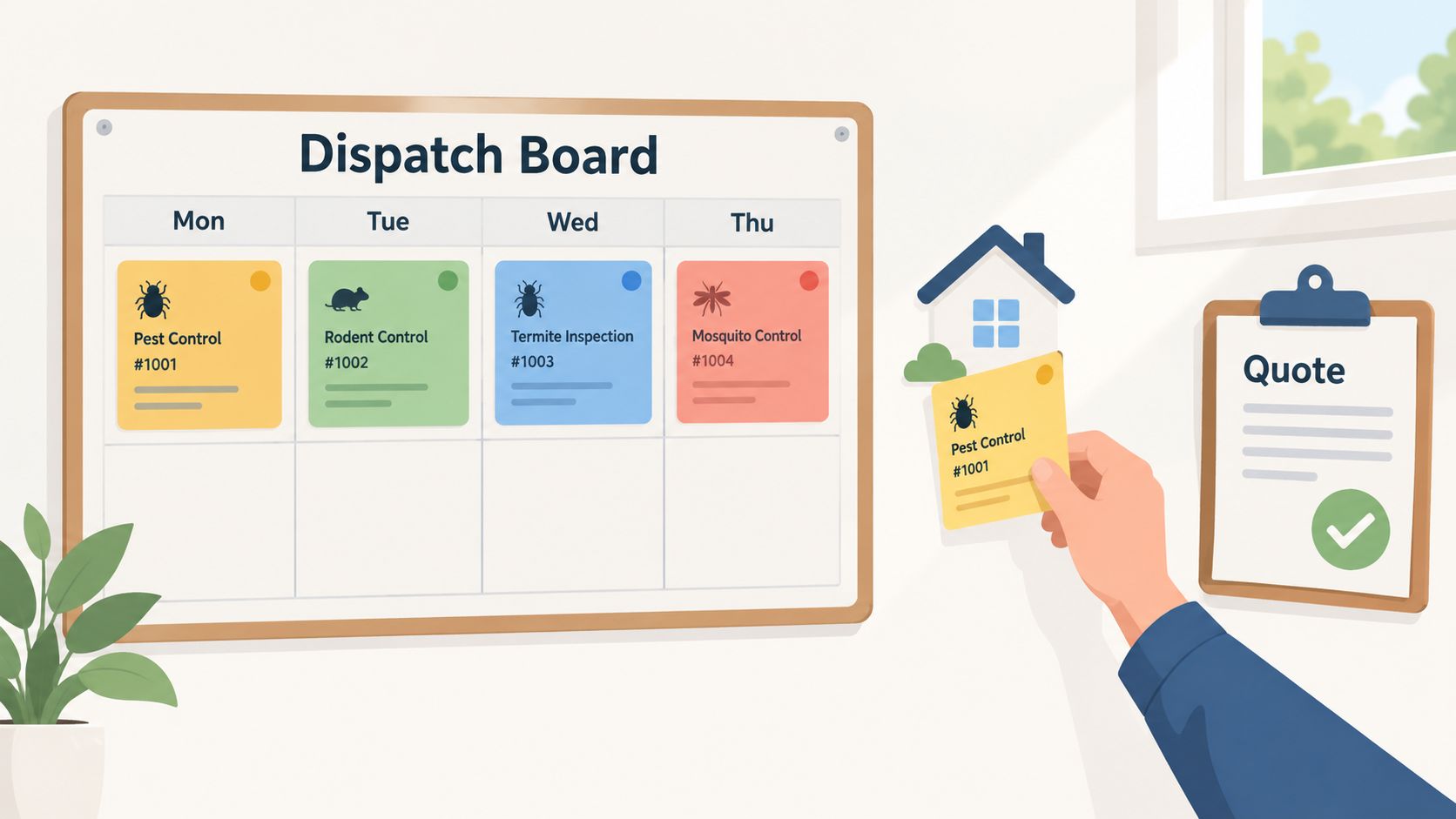
A cleaning or pest-control business may care most about recurring visits and customer communications. An HVAC contractor may care more about asset records, compliance evidence, stock, and job costing. Neither buyer should treat a general feature label as proof that the required workflow is native, included in the chosen tier, or suitable for the relevant jurisdiction.
Mobile Coverage, Offline Work, and On-Site Data Capture
A technician can have excellent scheduling software and still lose time if the job record disappears when the signal does. ServiceM8 is reported to support offline work and later synchronization, while Tradify requires an online connection according to its help-center guidance. ServiceM8 and Tradify mobile comparison
Device coverage creates a different trade-off. ServiceM8's native experience is described as strongest on iPhone and iPad, with fewer capabilities on Android. Tradify is listed across iOS, iPadOS, Android, Windows, Mac, and Linux, giving mixed-device businesses a broader starting point.
That doesn't mean app availability guarantees feature parity. An Android-dependent business should confirm whether technicians can complete the same forms, record time, attach photographs, access customer history, capture approval, and prepare payment information as an iPhone user.
A field workflow worth demanding in a demo
A buyer should ask the vendor to demonstrate the complete job while connectivity is disabled:
- Open an existing job and view its history.
- Complete a form or checklist.
- Add photographs and technician notes.
- Record time and materials.
- Capture customer approval or a signature.
- Queue the invoice or payment action for later synchronization.
- Restore connectivity and confirm what syncs, what conflicts, and what the office sees.
This matters in basements, plant rooms, rural properties, and new-build sites. If the system requires a live connection, the office may need to wait for the technician to reconnect or re-enter notes from paper.
The same workflow should be repeated on every device used by the crew. A platform that works well on an owner's iPhone may not provide the same field experience on an Android phone used by a subcontractor.
Migration, Switching, and What Happens to Your Data
Feature count gets attention because it is easy to display in a table. Data portability is harder to inspect and more important when the business changes systems.
An independent 2026 contractor-software survey reported that 34% of contractors changed their primary field-service platform during the prior 24 months. Among switchers, 48% cited price increases, 29% cited missing features, and 17% cited billing disputes or surprise fees. The survey also reported that 78% said customer and job-history data transferred cleanly through CSV export or vendor assistance, with a median migration time of 11 days. Its methodology and sample details aren't fully visible in the available result, so buyers should treat the findings as a prompt for due diligence rather than a universal benchmark. Independent contractor software spending survey
The same questions apply to both ServiceM8 and Tradify. A clean customer list isn't the same as a usable operational archive if property relationships, attachments, recurring schedules, invoice status, payment history, or custom fields are missing.
The export check before signing
Each vendor should answer these questions in writing:
- Customer records: Which contact, address, phone, email, and billing fields export?
- Job history: Do completed jobs retain dates, notes, photographs, forms, and technician details?
- Recurring work: Can active service plans and future visits be exported as working relationships rather than flat rows?
- Financial status: Do invoices, payments, credits, and outstanding balances retain their status?
- Custom fields: Are custom fields included, labeled clearly, and mapped to the correct customer or property?
- Post-cancellation access: How long does the vendor retain the account, and what deletion process applies?
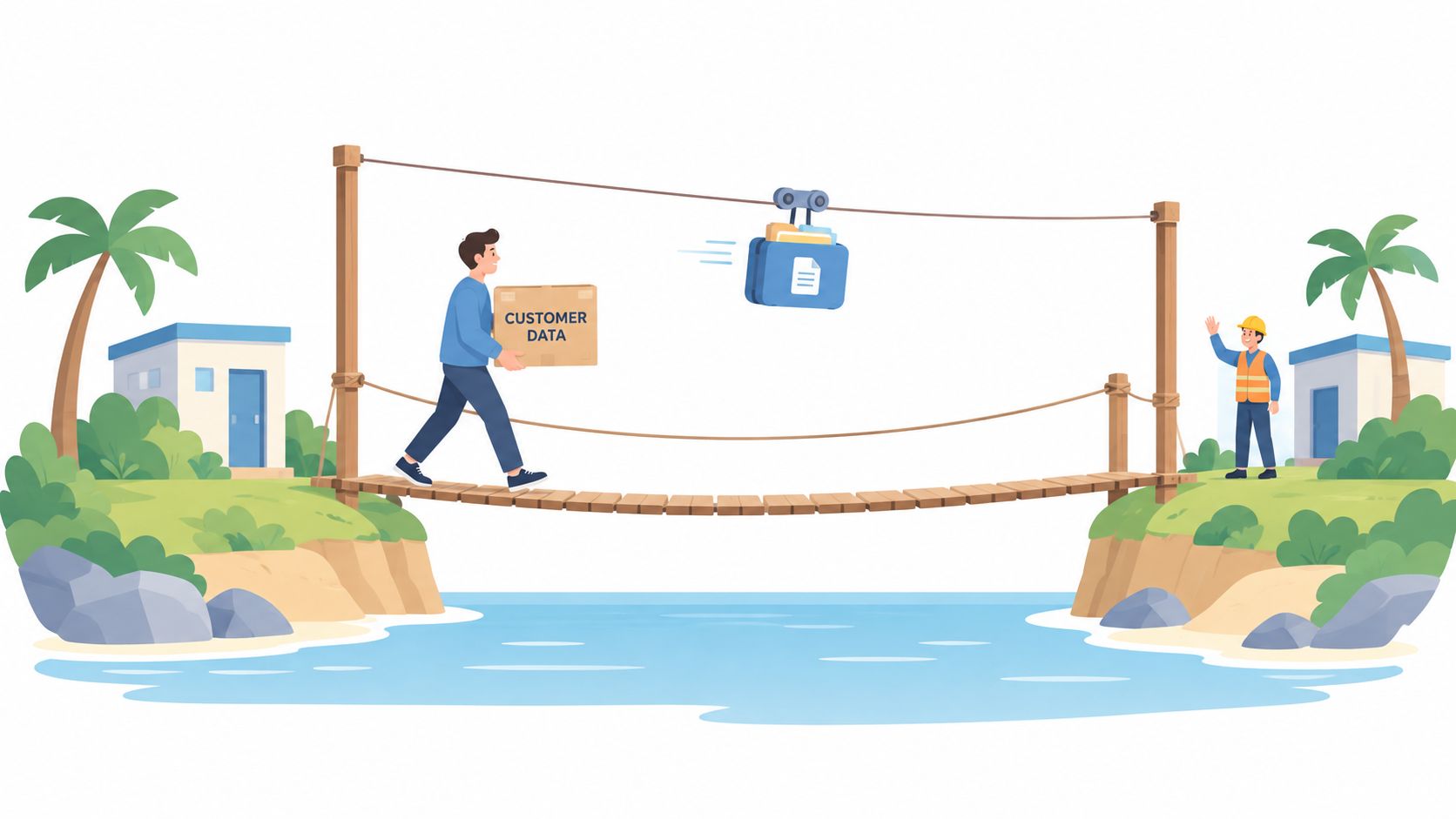
A practical request is a sample export containing five representative customers, including one recurring account, one property with attachments, one unpaid invoice, and one customer with custom fields. The buyer can then import that file into a test environment or spreadsheet and see whether the relationships survive.
Migration test: A platform with fewer headline features may be the safer choice if it offers a complete, predictable exit.
The contract should also address export fees, cancellation timing, retention, and deletion. Those terms deserve the same attention as the initial monthly subscription.
Hidden Fees, Gotchas, and Demo Questions to Ask
The published subscription is only one part of the operating cost. A small contractor should connect the plan to actual job volume, staff access, communication habits, payment methods, and future switching needs.
ServiceM8 buyers should confirm what happens when the selected job band is exceeded. Tradify buyers should ask whether subcontractors, part-time office staff, and read-only users consume paid seats. The public plan structures establish the main difference, but the order form should settle the edge cases.
Payment processing deserves a separate question. The business should request the current rates for card and ACH payments, any platform fees, and whether payment tools are included in the subscription or billed separately. SMS and email usage can also create extra charges or usage limits, especially for businesses that send appointment reminders, arrival messages, quote follow-ups, and payment notices.
Questions that should receive written answers
- Capacity: What is the exact excess-job charge for ServiceM8, and when does it apply?
- Seats: Does every Tradify login require a paid seat, including subcontractors and read-only office users?
- Connectivity: Which actions work offline in ServiceM8, and what happens when records conflict during synchronization?
- Android: Which Tradify and ServiceM8 functions differ across Android, iPhone, and iPad?
- Payments: What are the card, ACH, and platform charges for the intended country and currency?
- Messaging: Are SMS and email credits included, capped, or charged separately?
- Migration: Can the vendor provide an export containing customers, jobs, attachments, invoices, payments, and recurring schedules?
- Cancellation: What data remains available after cancellation, and what are the retention and deletion terms?
Automation should be tested as an administrative workflow, not accepted as a label. A business can ask each vendor to show an after-hours enquiry response, quote follow-up, recurring-job reminder, review request, payment chase, and dispatch change. The important details are human approval, message customization, audit history, and recovery after a failed or incorrect action.
Evidence on small-business AI adoption is mixed because surveys measure different groups and uses. A 2025 Thryv survey of 540 small-business decision-makers reported AI usage rising from 39% in 2024 to 55% in 2025, with 46% of users applying it to customer-engagement tools and 66% reporting monthly savings of $500 to $2,000. A separate SBA research brief reported 8.8% of small businesses using AI in its measured sample. Thryv survey reporting The discrepancy is a reason to test specific workflows rather than assume automation will reduce office work.
Which Vendor Fits Which Small Trade Business
ServiceM8 is the more natural candidate for an owner-operator or small crew with moderate, stable job volume, an iPhone and iPad environment, and a need for offline field access. Its unlimited-user structure on paid plans can make technician access easier to budget within the selected job band. That advantage weakens if job volume frequently approaches the cap or if the crew depends heavily on Android devices, stock control, or trade-specific compliance tools.
Tradify may fit a business with a fixed, small headcount that wants a per-user subscription and broader device coverage. Its sampled reviewer profile places greater emphasis on scheduling, quoting, and job costing, which may suit a contractor whose day revolves around fast estimates, planned visits, and material-aware job records. The trade-off is that every user needs to be included in the seat calculation, and online access becomes a central operating requirement.
Fit by business shape
A solo plumber working on an iPhone and entering sites with unreliable reception has a strong reason to examine ServiceM8 first. A two-person electrical business with Android and Windows users may prefer Tradify's wider platform coverage, provided its online requirement works at every regular job location.
A multi-trade business should be more cautious. HVAC, plumbing, and electrical firms need to confirm whether job costing, stock, planned maintenance, gas records, and other compliance workflows are native, restricted to a higher tier, or dependent on an add-on. A cleaning, pest-control, landscaping, or painting company should focus on recurring work, customer history, mobile forms, arrival messages, and payment collection.
The decision can be reduced to four written confirmations:
- Pricing: What will the business pay at its expected job volume and user count, including tax and payment charges?
- Mobile work: Can each technician complete the required field workflow on the device carried in the field?
- Migration: Can the vendor export the records the business needs if it leaves?
- Exit terms: What happens to the data after cancellation?
ServiceM8 suits businesses that want job capacity and Apple-focused offline work. Tradify suits businesses that want per-user predictability and broad device coverage. Neither should be selected from a feature list alone. The stronger choice is the one whose pricing, connectivity, trade workflows, automation controls, and data exit terms the owner can verify in writing.
Before committing, an owner-operator should ask ServiceM8 and Tradify for a written quote based on real monthly jobs, every required user, the business's currency and tax status, payment processing, messaging use, offline requirements, and the complete export and deletion policy. A short demo using one recurring customer, one unpaid invoice, one mobile device with no signal, and one Android device can reveal more than a long checklist.