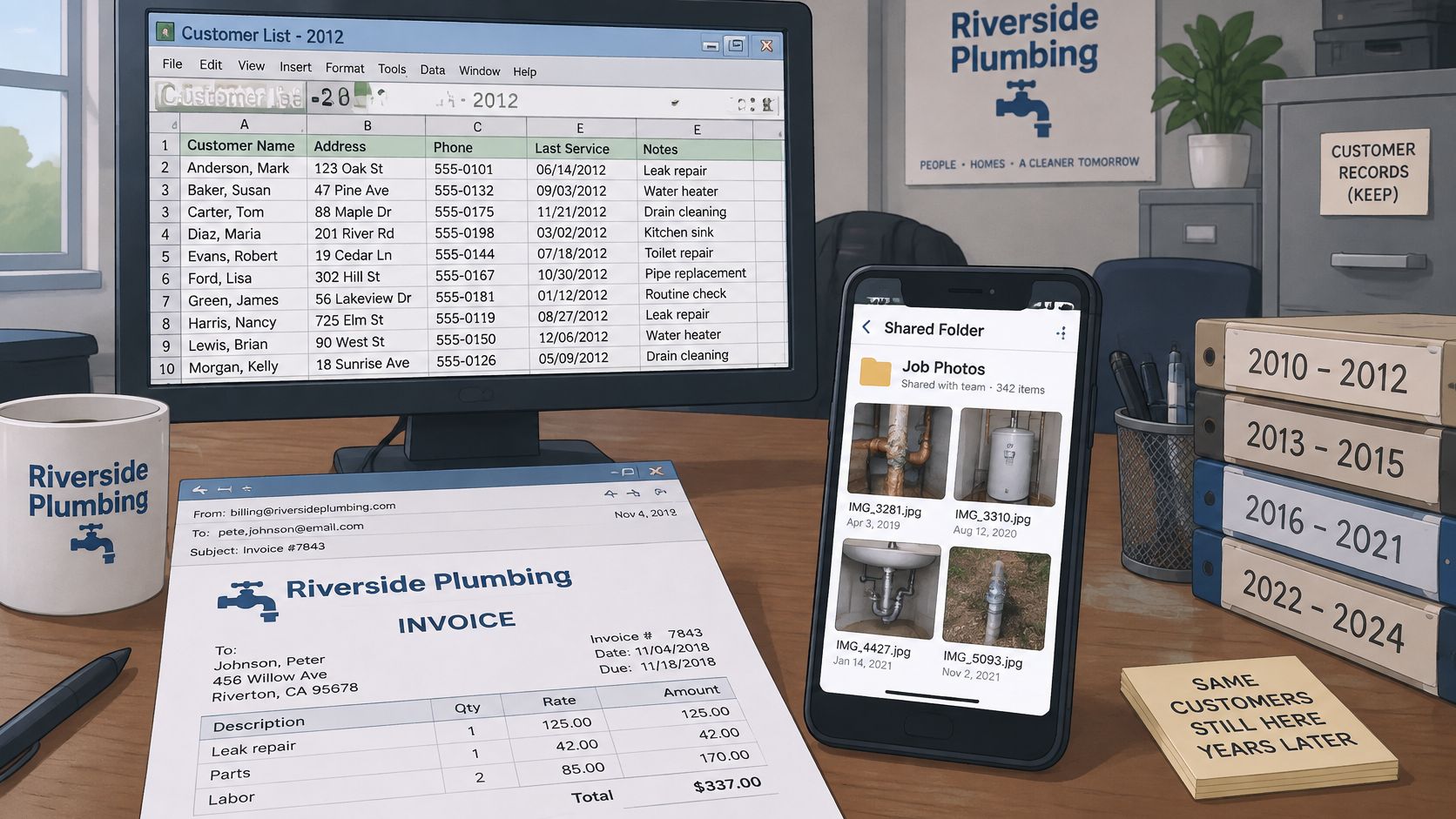
A plumbing office still has an old customer's job in a spreadsheet. A technician's photos sit in a shared folder, and an emailed invoice remains in an inbox. The owner is considering new software, but nobody knows which records must stay, which can go, or whether canceling the old account will remove them.
Data retention policies turn that uncertainty into a written set of decisions. The useful starting point isn't a blanket number of years. It's the business event that starts each record's clock, the reason for keeping it, and the action required when that reason ends.
What a Data Retention Policy Covers
A digital filing room needs the same order as a physical one: labeled drawers and a date on each folder. Without those labels, staff tend to keep everything because deleting anything feels risky.
A practical policy has these connected parts:
- Record category: What information exists, such as invoices or job photos.
- Business reason: Why the company needs it, such as supporting a tax return or handling a warranty claim.
- Retention period and trigger: How long it stays and which event starts the clock.
- End-of-life action: Whether staff delete it, anonymize it, or restrict access while a valid obligation remains.
Under the GDPR storage-limitation principle, personal information must stay no longer than its purpose requires, although legal obligations can justify longer retention, as the European Commission's GDPR principles guidance explains. That principle isn't a universal US deadline, but it illustrates why a documented purpose matters.
Separate records before setting dates
A home-service business should distinguish customer contact details, service history, invoices, payment records, employee information, marketing consent, and job photos. An invoice and a promotional mailing list don't serve the same purpose merely because both contain a customer's name.
Anonymizing means removing identifying information so the record no longer identifies someone. Restricting access means keeping a necessary record away from routine use, not treating it as deleted.
Practical rule: A record without a named purpose, review trigger, and responsible person needs a decision, not another storage folder.
Before choosing retention periods, the owner should be able to list the company's record categories and identify where each lives.
Typical Retention Periods and the Rules Behind Them
A retention schedule works like a row of kitchen timers. Each one starts at a different event and runs for its own length, so a single "keep everything seven years" rule will get some records wrong in both directions.
Retention periods by business record type
| Record type | Driver | Typical period | Note |
|---|---|---|---|
| Invoices and payment records | IRS general recordkeeping | At least 3 years as a general baseline, longer where needed to support reported income | Check state and accountant rules too |
| Payroll and employment-tax records | IRS employment-tax rule | At least 4 years after the date the tax is due or paid, whichever is later | Confirm the vendor keeps or exports this data |
| Quotes | Expiry and dispute window | Until the quote expires or any dispute ends | Set a review date |
| Job history by property | Warranty, safety, and recurring service | While needed for callbacks and service plans | No fixed number of years |
| Customer contact details | Service relationship and privacy rules | While the relationship is active, then delete or restrict where justified | No single statutory period |
| Deletion request records | CCPA regulations on consumer request records | At least 24 months | Keep the request and the response |
| Job photos | Warranty and dispute window | While the related job history is kept | Set the end date with an advisor |
| Marketing consent | Consent and purpose limitation | Until consent is withdrawn or its purpose ends, with necessary evidence handled separately | Review each year |
The IRS general recordkeeping guidance gives a commonly applicable three-year rule, while explaining that records must remain available as long as needed to prove income or deductions. For employers, the IRS employment-tax recordkeeping guidance says these records must be kept for at least four years after the date the tax is due or paid, whichever is later.
Those are different rules for different records. The employment-tax period is the longest fixed federal period in this table, and every other row follows its own clock.
Start the clock at a named event
A period without a starting event is incomplete. Staff need to know whether a clock starts when a quote expires, a job closes, a warranty ends, or a tax falls due.
For invoices and payment evidence, the accountant should identify the applicable tax rule and any circumstances requiring longer retention. A paid invoice may still support reported income. Closing the customer's service account leaves that obligation standing.
For payroll, the schedule should distinguish employment-tax evidence from other personnel files. A vendor's default archive setting can't carry the employer's recordkeeping duties.
For quotes, a concrete event works better than an arbitrary age. Say a painting company submits a quote that the customer never accepts. The office can schedule review after expiry, while preserving relevant records if a dispute remains unresolved.
For property-level job history, premature deletion can remove useful service evidence. An HVAC company may need equipment details and repair notes for warranty work or recurring maintenance. The same file rarely needs every outdated personal detail attached to that property.
Shorter retention isn't automatically better. The aim is to keep necessary evidence without keeping unrelated personal information indefinitely.
Separate legal minimums from business choices
The event-based approach distinguishes useful operational records from unnecessary personal information. A country-by-country retention-law overview describes how tax, employment, warranty, and privacy obligations can create different retention needs.
For customer contact details, an active service relationship gives the office a practical reason to retain current information. Once that relationship ends, staff should evaluate what remains necessary instead of leaving the entire profile available for future marketing.
Job photos need similar care. A photograph of a repaired pipe may support a callback, while an unrelated image showing a resident's belongings may have no continuing purpose. Linking photos to the relevant job makes review easier.
Marketing consent also needs a distinction between permission to send messages and evidence of a past permission or withdrawal. Withdrawal should stop the marketing activity; any retained evidence needs its own narrow purpose and access controls.
Apply the rule to the specific category
For covered businesses, California requires retention to be reasonably necessary and proportionate to the collection or processing purpose, according to the California Privacy Protection Agency's FAQs. The agency also explains deletion rights and exceptions for information that must legally remain.
A legal minimum establishes how long a relevant record must stay. A privacy limitation governs whether continued retention remains justified. The longest applicable minimum attaches to the affected category, so one long retention rule never justifies keeping every file that shares a customer's name.
California deletion-request logs carry a separate documentation obligation, so the request and response can outlast the underlying customer record. The policy should name that exception explicitly and keep the log narrow, rather than treating it as a reason to preserve the whole customer profile.
What Happens to Your Data After You Cancel
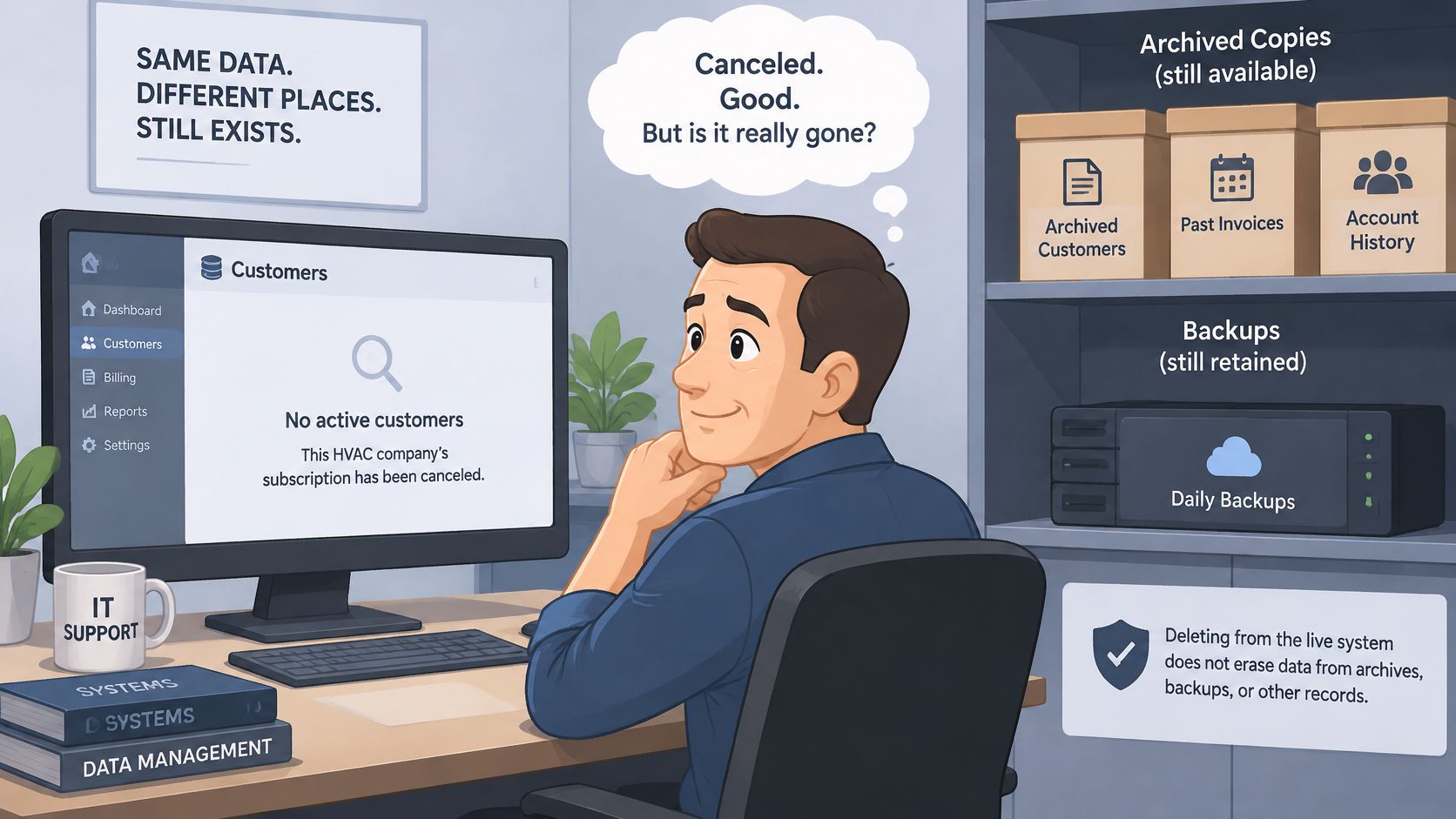
An HVAC company ends its software subscription. Staff can no longer open the customer database, so the owner assumes the information is gone. Loss of access isn't proof of deletion.
Where deleted customer data can still exist
| Event | What must happen | Where copies can remain | Common gap |
|---|---|---|---|
| Active record deleted | Removed from the live database | Nightly backups, cloud exports, downloaded spreadsheets | Copies persist in backups |
| Account canceled | Vendor deletes or restricts access as the contract states | Vendor backup generations and processor copies | Deletion timer runs with no notice |
| Switching software | Full export delivered before the end date | Old system, shared drives, email attachments | Partial export misses photos or notes |
| Backup restored | Deleted records must not return to ordinary use | Restored backup set | Deleted records reappear in the live system |
These events need separate controls. Deleting an active record concerns the working system. Canceling concerns the account relationship. Switching requires usable transfer files, while restoring requires safeguards against bringing erased information back into use.
NIST's storage-infrastructure security guidance recommends policy-based monitoring of backup operations and audit trails that show whether those operations conform to policy. For a small business, that means someone should be able to explain what the backup process does, not merely confirm that backups exist.
Backup expiry is a separate timetable
A nightly backup can preserve a customer record after staff remove it from the live system. The appropriate question is how long that backup remains recoverable and what prevents staff from using it as an unofficial archive.
EuroCloud's account-deletion analysis highlights inadequate erasure procedures, unclear retention periods, and backup-handling difficulties. Immediate removal from every historical backup may be technically impractical, making a controlled expiry process important.
A workable arrangement specifies:
- Production deletion: When information leaves active systems.
- Backup expiry: When recoverable backup generations expire, expressed in days.
- Restore controls: How prior deletions are reapplied before restored data returns to ordinary use.
A periodic restore test should check that last step. Otherwise, a successful recovery can recreate records the business had already removed.
Before cancellation, the office should map the copies it controls and run a test export. A spreadsheet containing customer names isn't a complete migration if technicians still need job photos, service notes, and attachments.
Contract Clauses That Control Your Data
Price and seat limits deserve attention, but they don't answer who controls business records after the subscription ends. A cancellation button may stop billing without establishing an export right or a deletion deadline.
The relevant wording may appear across the vendor's terms of service, privacy policy, data processing addendum, and signed order form. A data processing addendum is the agreement describing how a provider handles personal information for the customer. The documents should agree, including any negotiated promises.
Terms that need concrete wording
- Ownership and permitted use: The agreement should state that the business owns its customer records and explain what the provider may do with them.
- Export rights: It should name the formats, included fields, attachments, delivery process, and any export charge.
- Live-system deletion: The deadline should be a defined period after a named event, not an open-ended promise.
- Backups and archives: Separate wording should establish expiry and restrictions on restored copies.
- Other providers and connected apps: The agreement should identify responsibility for outside services handling the information. These providers are often called subprocessors.
- Exceptions and confirmation: Legal preservation, tax-related retention, decision ownership, and written completion notices should be explicit.
California's requirement to retain deletion requests and responses for at least 24 months, described in the California privacy statute and related deletion provisions, illustrates why erasure and documentation aren't the same task. The provisions also distinguish existing systems from archived or backup systems, making blanket deletion promises insufficient.
Reject an undefined finish line
Wording such as retention as needed leaves the business unable to calculate an end date. A reference to the vendor's policy is only useful if the applicable policy supplies an identifiable rule.
Contract check: A usable clause establishes an event, a deadline or objective rule, a responsible party, and any exceptions.
A legal hold means preserving relevant information because of a dispute, investigation, or other preservation duty. It should identify the affected records, the person authorizing the hold, and how release is approved. It shouldn't become a reason to keep unrelated files indefinitely.
For a business evaluating Housecall Pro, Jobber, ServiceM8, or another field-service platform, a sales assurance should become written contract language or an attached written commitment. A feature demonstration doesn't establish post-cancellation rights.
Vendor Questions to Put in Writing
A vendor should be able to explain its retention process without relying on a sales representative's general reassurance. Written responses give the office something specific to check when an export fails or a deadline passes.
Questions and usable answers
Can the business export every record, including photos, notes, and attachments, and in what format?
A usable answer names the file formats and fields. It distinguishes structured records from separately delivered files and explains how attachments remain associated with jobs.How many days after cancellation are records deleted from live systems?
The answer gives a number of days and identifies the starting event. Subscription expiry, cancellation notice, and account closure shouldn't be treated as interchangeable.How long do backup copies persist after deletion, and when do they expire?
A specific answer provides an expiry in days. It also identifies any archive or offline copy governed by a different rule.Do subprocessors and connected apps follow the same deletion timetable?
The response names the services, their deadlines, and who sends the deletion instruction. Independently connected apps may require action by the business.After a backup restoration, are previously deleted records removed again automatically?
The vendor should describe the deletion-reapplication step and any manual approval. Saying that backups are secure doesn't answer this question.Will the business receive written confirmation of deletion, and when?
The answer promises a dated notice and defines its scope. Confirmation of live-system deletion should distinguish backup expiry still pending.Which legal holds or tax-related exceptions can extend retention, and who decides?
The response names the rule, affected information, and decision owner. It should also explain how the exception ends.Which vendor role owns a missed deletion request?
A usable answer identifies a responsible role and escalation path, rather than directing the office back to a general support queue.
An unanswered question is a known contract risk, not a detail to resolve after cancellation.
The office manager should file these answers with the signed agreement. If support and sales give conflicting responses, the vendor should reconcile them in writing before signing.
Confirm Your Retention Schedule Before You Sign
A usable schedule connects daily recordkeeping with the software agreement. It should be simple enough for an owner-operator to maintain and clear enough for an office employee to follow without guessing.
- Map each category. Match the business's records to an applicable period or event. Flag unclear tax, employment, and privacy obligations for an accountant or attorney.
- Record the reason. Name the rule or business need behind each decision, including the longest applicable minimum for that category.
- Assign the final action. Specify deletion, anonymization, or justified restricted access, with a named person responsible.
- Schedule review. Set an annual review and earlier triggers, such as entering another state, adding a service line, or changing software.
- Resolve vendor questions. Obtain written answers before signing and keep them with the agreement.
- Prepare the exit. Identify backups, exports, connected systems, and downloaded spreadsheets. Confirm a test export is usable before ending access.
Keep the schedule usable as the crew grows
A policy shouldn't depend on the owner remembering every exception. As staff take over billing, dispatch, or payroll, each category needs an identifiable owner and a repeatable review task.
This week, the business owner should write the schedule for employee information, customer contact details, and payment records, including each trigger, retention reason, storage location, and end-of-life action. Those completed entries provide a concrete starting point for the rest of the policy.