The ladder is back on the rack and there's a photo on the phone: a two-story colonial with green algae running down the north wall, plus a message asking what it costs to wash the siding and clear the gutters.
Whatever number goes back tonight decides two things at once. It decides whether the job gets booked, and it decides whether the job earns anything.
Most owners answer from memory. The last house like that one took a day and a half, so this one gets the same figure, rounded down slightly to look competitive. Then the job runs long, someone makes a second trip for a part, the dump charges by weight, and the margin that looked fine on Tuesday is gone by Friday.
The fix isn't a sharper gut feeling. It's treating every quote as two documents stacked together: a short, plain-language summary the customer reads and approves, and an internal cost worksheet the customer never sees but the price depends on. Get both right and the price is defensible to the homeowner on the driveway and to the crew who has to do the work.
Six Steps to Quote a Job
A pressure washing outfit prices a driveway, a rear patio and a low garden wall at $650 from three phone photos. The crew arrives to find a hose bib that has to be moved, a gate that comes off its hinges, and a wall that needs a chemical pre-treat the number never covered. The job takes nine hours instead of five. Nothing was wrong with the price except that a step got skipped before it was written.
Six steps close most of that gap, and none takes longer than a slow walk around the property.

- Put the scope in words before the price. Name the service, the surfaces or assets it covers, and what it leaves out. A quote without exclusions turns into a fixed price for whatever the customer pictured. The common slip is quoting a service label, such as "full exterior wash," instead of the actual work.
- Measure on site. Record the units that drive cost: square footage, window count, rooms, zones, fixtures, equipment age, access. Precision follows information. A Project Management Institute review of estimating practice puts typical accuracy at roughly 30 to 50 percent at the conceptual stage and about 10 percent at tendering. A phone estimate is a conceptual estimate, so price it like one and label it like one.
- Estimate hours task by task. Walk the job in sequence: setup, prep, the main work, cleanup, haul-away. The slip here is remembering how long a similar visit felt rather than counting the tasks inside it.
- List every non-labor cost. Materials and consumables, equipment, travel and fuel, disposal, permits, and any subcontractor bid. A bid that doesn't exist yet means part of the quote is still a guess.
- Add overhead and margin, then test the total. A price that covers the job still has to cover the business. Run it against the break-even count before it goes out.
- Compare the finished job with the quote. When the invoice is paid, put actual hours and costs beside the estimate. Change the price book only once the cause of the gap is known.
Step six is where a quoting habit becomes a quoting system. Historical pricing is the most common basis for final cost estimates in U.S. road work: a 2014 Federal Highway Administration review found that 37 of 50 responding states, or 74 percent, named historical bid-based estimating as their primary technique. The logic carries over to a $650 driveway wash, with one condition: the earlier job has to be comparable in size, surface, access and condition. A price book full of jobs that don't match is a guess with a spreadsheet around it.
The Test of a Finished Quote
Ask one question before sending. Could a crew member who never visited the property read this quote and know exactly what to do, with what, and what to leave alone?
If the answer depends on phoning the owner, the quote isn't finished. It's a starting point with a price attached.
Labor and Material Cost Worksheet
Two estimates can price the same five-hour job very differently. One divides labor cost by paid hours. The other accounts for the hours a crew can spend on billable work. That difference can erase margin.
The Denominator That Changes the Rate
Use productive hours, not all paid hours, to calculate the labor cost behind a quote. For planning, an owner might assume that 80 to 85 percent of a paid week is productive time. On a 40-hour week, that is about 32 to 34 hours. Travel, setup, loading, customer calls, meetings and training still take time, even when they do not produce billable work.
Suppose a technician's weekly cost, including wages, payroll taxes, insurance and benefits, is $1,200. Dividing by 40 paid hours gives $30 an hour. Dividing by 32 productive hours gives $37.50. On a five-hour job, that difference adds $37.50 to the labor cost.
Build job conditions into the time estimate. Difficult access, weather, property condition and crew size can change how long the work takes. Record those factors in the worksheet and explain relevant ones in the written quote, so the customer can see what the price covers.
The Six Cost Lines
| Cost line | What to include | How to calculate | Common miss |
|---|---|---|---|
| Labor | Every technician hour on site and in transit | Task hours divided by the productive share, multiplied by loaded hourly cost | Using wages instead of loaded labor cost |
| Materials | Parts, consumables, chemicals and fasteners | Measured quantities multiplied by supplier prices, plus a waste allowance | Forgetting caulk, cleaner or other consumables |
| Travel and fuel | Drive time and mileage to the site | Miles multiplied by cost per mile, plus drive time | Ignoring windshield time |
| Disposal and permits | Dump fees, haul-away and permit costs | Use the known fee from the facility or permit office | Leaving fees out of a fixed price |
| Subcontractors | Outside electricians, haulers or specialists | Add the bid and coordination time | Quoting before the bid arrives |
| Equipment | Rented or specialty machines | Daily rental rate multiplied by days, plus setup and transport | Forgetting setup and transport |
Measure materials from the scope, not from what happens to be on the truck. Add an allowance for cuts and spillage, then list the small supplies crews may overlook: caulk, fasteners, tape, cleaning chemicals, stain remover and trash bags. For example, a 10 percent allowance on a $400 material list adds $40.
A blank line still costs money. If it is missing from the quote, it comes out of the amount left after job costs.
Once the job is complete, record hours by task, material quantities, fees and subcontractor costs. Compare those figures with the worksheet. As the records build, use the results to refine production assumptions for specific trades and tasks. That gives future quotes a clearer cost basis and helps keep the written price understandable to both the crew and the homeowner.
Set Overhead and Margin With a Break-Even Check
Job costs and business costs are different animals. Labor, materials, fuel, disposal and subcontractors belong to the job. Rent, software, insurance, vehicle payments and phone service belong to the business whether or not a single job gets sold.
The U.S. Small Business Administration states the break-even formula as fixed costs divided by (price minus variable costs), which gives the break-even point in units. For a service business, the units are jobs.
Break-even jobs = fixed monthly costs divided by (job price minus job costs). If the answer is larger than the number of jobs the crew can physically finish in a month, the price is too low no matter how healthy each individual job looks.
A Worked Example
Take fixed costs of $6,000 a month: rent on a shop bay, insurance, two vehicle payments, software, phone, and the office manager's hours. A job is priced at $300, and the labor, materials and fuel for that job come to $120. That leaves $180 of contribution per job. Divide $6,000 by $180 and the business needs 34 jobs a month just to break even. Profit starts at job 35.
Watch what a discount does to that count. Knock 10 percent off the price and contribution falls to $150, which pushes break-even to 40 jobs. The discount didn't trim profit. It added six jobs of unpaid work. Every discount should be calculated against the margin it leaves, not against the list price.
The SBA also separates one-time costs from monthly ones, and the split matters when a quote is being tested. One-time costs include licenses, permits, legal fees, signage and technology. Monthly costs include salaries, rent and utilities. Both have to be recovered, but only the monthly group belongs in the break-even count.
The Check That Catches a Bad Price
Add up the jobs the crew can realistically complete at the proposed price in a normal month, then compare it with the break-even count. If capacity falls short, the fix is either a higher price, a lower job cost, or a smaller fixed cost base. Raising volume on a price that doesn't cover overhead just buys more of the same problem.
Write Scope, Exclusions and Approval Terms
A homeowner compares two quotes for the same driveway. One says “pressure wash: $650.” The other names the surfaces, work included, exclusions, optional services and approval terms. The second is easier to judge, even if the prices differ. In the 2025 Modernize homeowner insights report, unclear quotes, poor communication and pushy sales tactics were among the reasons homeowners disengaged.
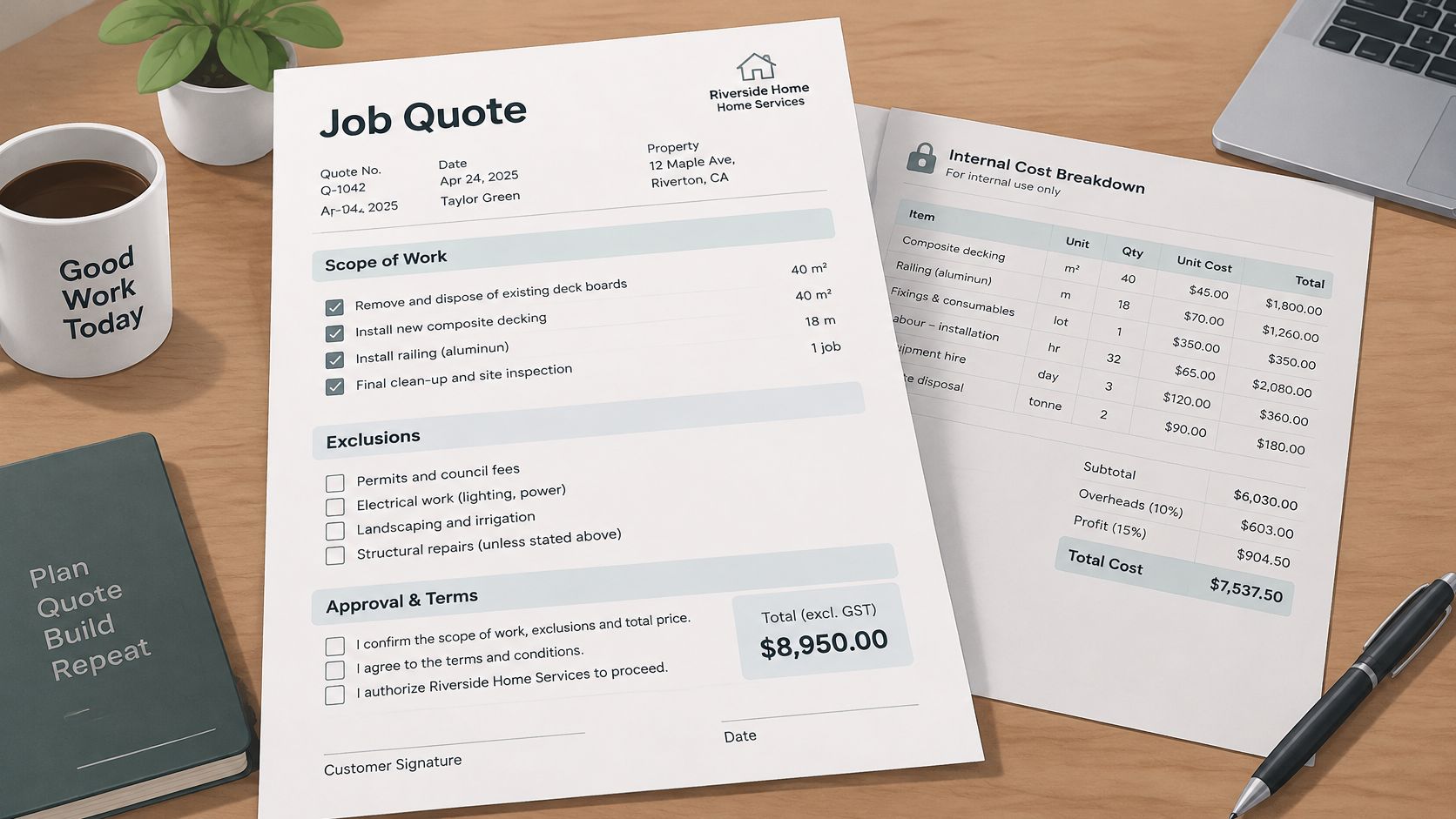
Write the quote as a customer-clarity document backed by an internal cost worksheet. The customer needs a clear description of the work and price. Your worksheet supports that price with labor, materials and other job costs. Keep the customer-facing summary concise; put detailed cost calculations in the worksheet.
What the Summary Carries
Driveway and front walk, pressure wash
Surface: about 900 sq ft of concrete driveway plus 120 linear ft of walk.
Included: pre-treat algae and rust stains, surface clean, post-rinse, and blow debris clear.
Not included: oil stain removal, sealing, or roof and siding work.
Optional: one coat of concrete sealer, add $180.
Price: $650. Valid until the 14th. A 25 percent deposit books the date.
Use measurable units so the customer can see what the price covers. Depending on the job, specify square footage, fixtures, rooms, zones, plants, equipment or labor hours. State exclusions in plain language too. For example, name stain removal, roof work or hauling debris left by another trade if those tasks are not included.
The Change-Order Rule
SBA guidance on government contracts says a contractor must deliver the service described in the specifications. It also explains that a change within the general scope can justify a fair adjustment to price and schedule. That guidance covers federal contracts, while the same basic practice helps prevent confusion on residential work.
Write down the change before the crew proceeds. Hidden rot behind a fascia board, a failed shutoff valve, difficult access or a request to add a zone can change the work. Describe the added task, its price and any schedule change, then get the customer's approval. Otherwise, the original price may be treated as covering work the quote never described.
The Approval Block
End with clear terms. State how long the price holds, the acceptance deadline, any deposit and how the customer can approve the quote, such as by signing on a phone or replying to the email. If the scope needs an on-site diagnosis, explain how the diagnostic or service fee applies and whether it credits toward the work.
Quoting Software for Home Service Businesses
Software does one job in this process: it carries the approved quote and the cost record from the driveway to the invoice without anyone retyping them. It doesn't set the price, and it can't fix a worksheet with a blank disposal line.
What the Quote Needs From the Software
- Quote to invoice without re-entry. An approved quote should become a job and then an invoice with the same line items intact.
- Approval at the property. The customer signs or accepts on a phone while the crew is still there, which is when the decision is easiest to make.
- Deposit at approval. Collecting part of the money at acceptance separates a booked job from a maybe.
- History by address. The last three visits to that property, with what was quoted and what was used, are the raw material for the next price.
- A schedule entry on booking. A quote that wins but never reaches the calendar is a job that gets lost.
Four Vendors to Compare
Fit depends on trade and crew size. A one-person pressure washing or lawn care operation needs a simple mobile quote and few logins. A six-person HVAC or plumbing crew needs technician accounts, dispatch and job costing, and the plan tier changes the monthly cost.
| Vendor | Quote to invoice path | Trades and crew size it fits | Published price on vendor page |
|---|---|---|---|
| Jobber | Approved quote converts to a job and an invoice with line items preserved | Broad home service, from one user to larger crews | Core at $39 per month billed annually (Jobber pricing), read October 20, 2026 |
| Housecall Pro | Quote built in the app, accepted on the customer's phone, invoiced from the same record | HVAC, plumbing, electrical, cleaning and similar trades, one to several trucks | Basic at $79 per month billed annually (Housecall Pro pricing), read October 20, 2026 |
| ServiceM8 | Quote to job card to invoice, with the job card carrying tasks and materials | Solo operators and small trade crews working from a phone | Starter at $29 per month (ServiceM8 pricing), read October 20, 2026 |
| GorillaDesk | Quote with recurring service plans converts to a scheduled job and an invoice | Pest control, lawn care, cleaning and pool service, one to about ten users | Starter at $49 per month (GorillaDesk pricing), read October 20, 2026 |
Per-technician charges, card processing rates and setup fees often sit outside the headline figure, so confirm them with the vendor before buying. The rule that keeps this simple: the software should carry the approved quote and the cost worksheet. It never replaces either one.
Review Quotes Against Actual Job Costs
The review at closeout is where a price book gets honest. Pick the next three jobs that will go out as quotes, price each one with the worksheet before the crew is booked, and save the full estimate with its line items.
When each job closes, enter actual hours, materials, fees and subcontractor invoices beside the estimate and calculate the variance line by line. Job costing earns that effort. In a U.S. survey of 1,341 business owners and finance professionals across seven industries, 76 percent of those using job-costing or accounting software reported estimates that were close to or accurate against final project costs, against 64 percent of those relying on memory, paper or spreadsheets (survey summary). The same survey suggests a workable control: investigate any labor or material category that lands more than 10 percent above estimate before that price is used again.
Keep the evidence behind every number. SBA Form 1244 treats contractor costs, estimates, vendor quotes for machinery and equipment, and itemized estimated professional fees as key cost documents. For a service business, that means supplier quotes, equipment rental pricing, disposal and permit receipts, and subcontractor bids filed with the job. Those records show whether an allowance was ever a firm cost, and they make a revision defensible when material prices or site conditions change before scheduling. They matter most on HVAC replacements, electrical upgrades, plumbing work, landscaping installs and anything requiring permits or rented equipment.
The only question that counts after the third job. Did the price cover the labor, the overhead and the margin the worksheet predicted? If it didn't, find the line that moved before the next quote goes out.
Prices change, and plans get renamed, which is why JobsiteStack tells readers to confirm the current figure with the vendor before buying rather than relying on a figure recorded on any other day.
Before the next quote leaves the phone, write the scope in plain language, measure the property, and fill in the six cost lines: labor at its real productive rate, materials with a waste allowance, travel, disposal and permits, subcontractor bids, and equipment. Send the customer a summary they can compare against two other quotes and understand in thirty seconds. Then put the actual hours and costs beside the estimate when the job closes, and change the price book only for the line that moved.