
A homeowner calls about ants along the kitchen baseboard and asks for the monthly price. The operator has a route, a truck, and a product shelf, but the number that gets quoted is often a round figure from the last similar house. Two homes on the same street can need different minutes, different access, and different paperwork. A pest control pricing guide only helps when it starts from those inputs, then shows how billing cadence, renewal, and add-ons change what the customer pays in the first year.
The visit fee is the building block. The plan price is that fee times the visits that will be done, plus anything the agreement adds later.
Pricing Models for Each Treatment and Frequency
Most pest businesses sell a short list of billing structures. A one-time treatment is a single job. A per-visit service charges only when a technician shows up. A quarterly recurring plan schedules four visits a year. A monthly recurring plan bills every month, sometimes for work that happens less often. An annual contract ties the customer to a year, often with monitoring or a warranty. Specialty work, especially termites and mosquitoes, splits inspection, treatment, and monitoring into separate parts.
| Model | How it is billed | Best fit | Risk to watch |
|---|---|---|---|
| One-time treatment | Flat fee for one visit | A single pest event or first visit | No follow-up visit is included, so a return visit is unpriced |
| Per-visit service | Fee for each visit when performed | Irregular or seasonal pests | Gaps in revenue between jobs |
| Quarterly recurring plan | Fee per quarter, four visits a year | General pest prevention | Payment cadence can differ from service cadence |
| Monthly recurring plan | Fee billed each month | Ongoing monitoring of a property | Billed monthly for quarterly or bi-monthly visits |
| Annual contract | Yearly commitment, sometimes with a discounted first visit | Termite monitoring and warranties | Renewal, early-termination and cancellation terms |
| Specialty program (termite, mosquito) | Inspection, treatment and monitoring priced as separate parts | Structural or seasonal risk | Retreatment and warranty terms that shift cost |
A one-time visit has to carry its full cost on that invoice. Labor, travel, product, and a return trip if one is promised all sit in one number. A recurring plan spreads setup across the year, but only if every scheduled visit is delivered. Miss a quarter and the cheap per-visit math no longer holds.
Where billing disputes start
Two rows cause most of the arguments. On a quarterly plan, service can be every three months while the card is charged every month. On a monthly plan, the invoice can keep running for bi-monthly or quarterly work. The headline monthly amount is not the full price when the agreement has a term, a discounted first visit that must be earned out, or retreatments that were never written in.
Practical rule: Sell a one-time visit for a single event, a quarterly plan for prevention, and an annual contract only when monitoring or a warranty is part of the job.
Match the model to the work mix. General pest prevention belongs on a quarterly plan with the visit count written next to the payment schedule. Termite and mosquito programs should not be folded into that same flat fee.
Compliance Records and Certification Costs
Restricted-use work changes who can take the job and what the office has to keep afterward. Under 40 CFR 171.311, a commercial applicator must be certified for each applicable category and subcategory when applying a restricted-use pesticide or supervising that application. Certification is not an optional badge on the quote. It decides which technician can run the route and whether a certified person has to stay on the job.
Records follow the application. The EPA applicator recordkeeping requirements say commercial applicators operating under the federal plan must retain records for at least two years and make them available for inspection and copying. Each record must identify the customer's name and address, application location, treated-area size, treated site, application date and time, product brand, EPA registration number, total amount applied, and the certified applicator's name and certification number.
Deadlines that belong on the job cost
The USDA pesticide recordkeeping guide states that required restricted-use records must be maintained for two years and recorded within 14 days of application. Commercial applicators must furnish the customer a copy of the required data elements within 30 days of the application. Those clocks are labor, not a footnote.
A low visit price that ignores this work understates the job, especially on commercial or regulated accounts. Put documentation and the customer copy inside the visit price, or bill them as their own line. Either way, estimate the paperwork minutes and carry them into the compliance line of the price build-up.
Capture these fields on every restricted-use job before the technician leaves the property:
- Customer and site: Name, address, application location, treated site, and treated-area size.
- Timing: Application date and time, plus the date the record was written, inside 14 days.
- Product: Brand, EPA registration number, and total amount applied.
- Applicator: Certified applicator's name and certification number.
- Customer copy: Who received it, and whether that happened within 30 days.
Build a Quarterly Visit Price Step by Step
Two ant jobs on similar houses can leave the office at $180 and $240. The gap is rarely the ounce of product. It is diagnosis time, drive time, access, and whether anyone priced the paperwork.
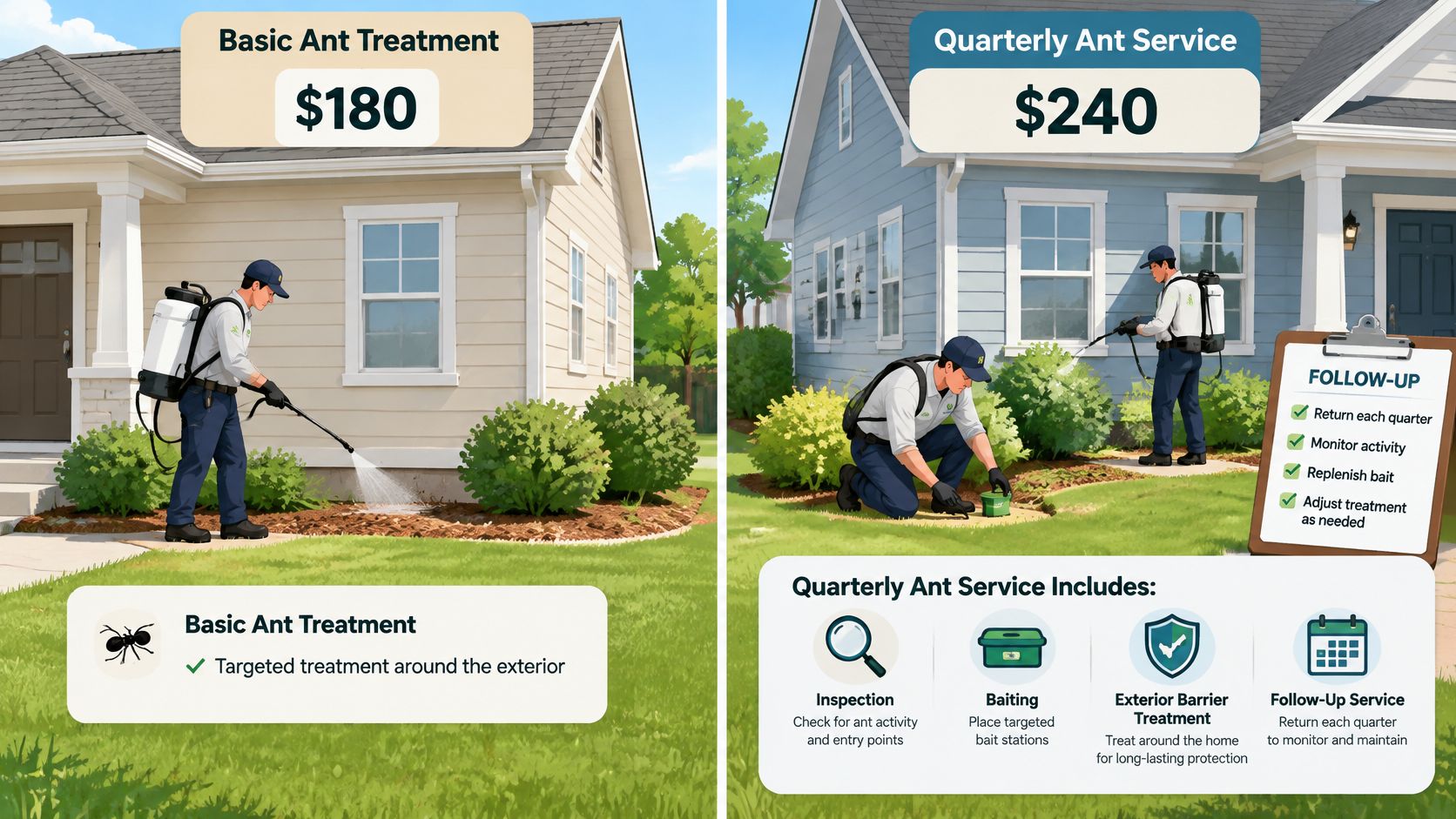
Chemical volume is a poor stand-in for a service invoice. An EPA pesticide market estimates report put U.S. pesticide-user expenditures at approximately $8.3 billion in 1991, up from $8.0 billion in 1990, with agriculture accounting for more than two-thirds of that spending. A customer is paying for inspection, travel, labor, application, documentation, and follow-up.
A defensible visit price records five drivers on the job. Labor covers diagnosis, treatment, and documentation minutes. Materials use product cost per unit times the label amount for the treated area, perimeter, or bait count. A vineyard pesticide budget walkthrough shows the same idea with a product at $0.75 per mixed gallon. Travel is round-trip miles and drive time. Equipment is sprayers, protective gear, bait stations, and truck wear, split per visit. Overhead is insurance, licensing, software, and office cost divided by billable visits. Pest type, access, infestation level, and callback risk change the minutes.
Nine steps and a sample build-up
Every figure in the table is a sample. Replace it with the crew's own minutes, rates, and miles.
- Record minutes for inspection, application, and paperwork.
- Multiply those minutes by the loaded hourly labor rate.
- Add product cost for the label amount, not a guess from memory.
- Add travel cost from miles and drive time.
- Add a per-visit share of equipment and protective gear.
- Add compliance and records time.
- Add overhead per billable visit.
- Add margin to full cost to reach the visit price.
- Multiply the visit price by visits per year for the plan value.
| Line item | Calculation (sample input) |
|---|---|
| Labor | 45 minutes at $50 per hour = $37.50 |
| Materials | 1 gallon at $0.75 product cost = $0.75 |
| Travel | 12 miles at $1.00 per mile = $12.00 |
| Equipment and protective gear | Sample per-visit share = $6.00 |
| Compliance and records | 10 minutes at $50 per hour = $8.33 |
| Overhead | Sample $9.00 per billable visit |
| Full cost | Sum of the lines above = $73.58 |
| Margin | 25% markup on full cost = $18.40 |
| Visit price | Full cost plus margin = $91.98 |
| Quarterly plan value | Visit price times 4 visits = $367.92 |
Fifteen more drive minutes at $50 per hour adds $12.50 to full cost before markup. One extra callback each quarter is another visit of labor and travel that the $91.98 never collected. Write the nine-step formula into the quote template so each job reruns it with its own minutes and miles.
Margins, Add-Ons and Surcharges
Markup and margin are not the same number, and mixing them up is how a "25 percent job" becomes a thinner one. On the sample full cost of $73.58, a 25 percent markup produces $91.98. That price is a 20 percent margin, because $18.40 divided by $91.98 is about one fifth, not one quarter. Operators who set markup and then report margin as if they match will think the job funds callbacks when it does not.
Margin has to cover callbacks, slow payers, and seasonal gaps, not only profit left after a clean visit. If retreatments are common on a pest, raise the margin or price a set number of return visits inside the plan. Do not hope the base fee absorbs them.
Price extras before the truck rolls
Add-ons should sit on their own lines. Folding them into a low base price hides the cost and invites a dispute when the invoice is higher than the spoken quote.
| Add-on | When it applies | How to price it |
|---|---|---|
| Crawl-space or attic access | Entry needs special gear or time in tight areas | Flat fee or extra labor time |
| Exclusion or sealing | Entry points must be closed | Quoted by linear foot of work |
| Emergency or same-day dispatch | Visit falls outside the scheduled route | Flat surcharge stated on the quote |
| Extra retreatment | Pests return before the included visits are used | Included in the plan or a flat fee |
| Structural repair | Damage found during inspection | Quoted separately, outside the treatment price |
| Bait station installation | Stations are placed and checked | Per station plus monitoring visits |
A crawl-space fee applies when the technician needs extra time or gear, and it should be a flat amount or added minutes on the written quote. Exclusion is linear feet of sealing, measured before the price is given. Same-day dispatch is a flat surcharge named before the route is broken. Extra retreatments are either inside the included count or a flat fee, never a silent free visit. Structural repair found on inspection is a separate quote, outside the treatment price. Bait stations are priced per station, with monitoring visits listed beside the count.
A surcharge that first appears on the invoice creates disputes and bad reviews.
Attach every add-on to the quote template as its own line, with a zero when it does not apply, so the customer sees the choice before work starts.
Contract Terms That Change the Real Price
A $79 first visit can seem cheaper than a $180 one-time treatment. Spread it over a twelve-month commitment, include a monthly charge for four visits, and add a cancellation fee, and the first-year total may exceed the cost of the single higher visit. The actual cost of a recurring plan is the first-year total, not the advertised monthly or per-visit price.
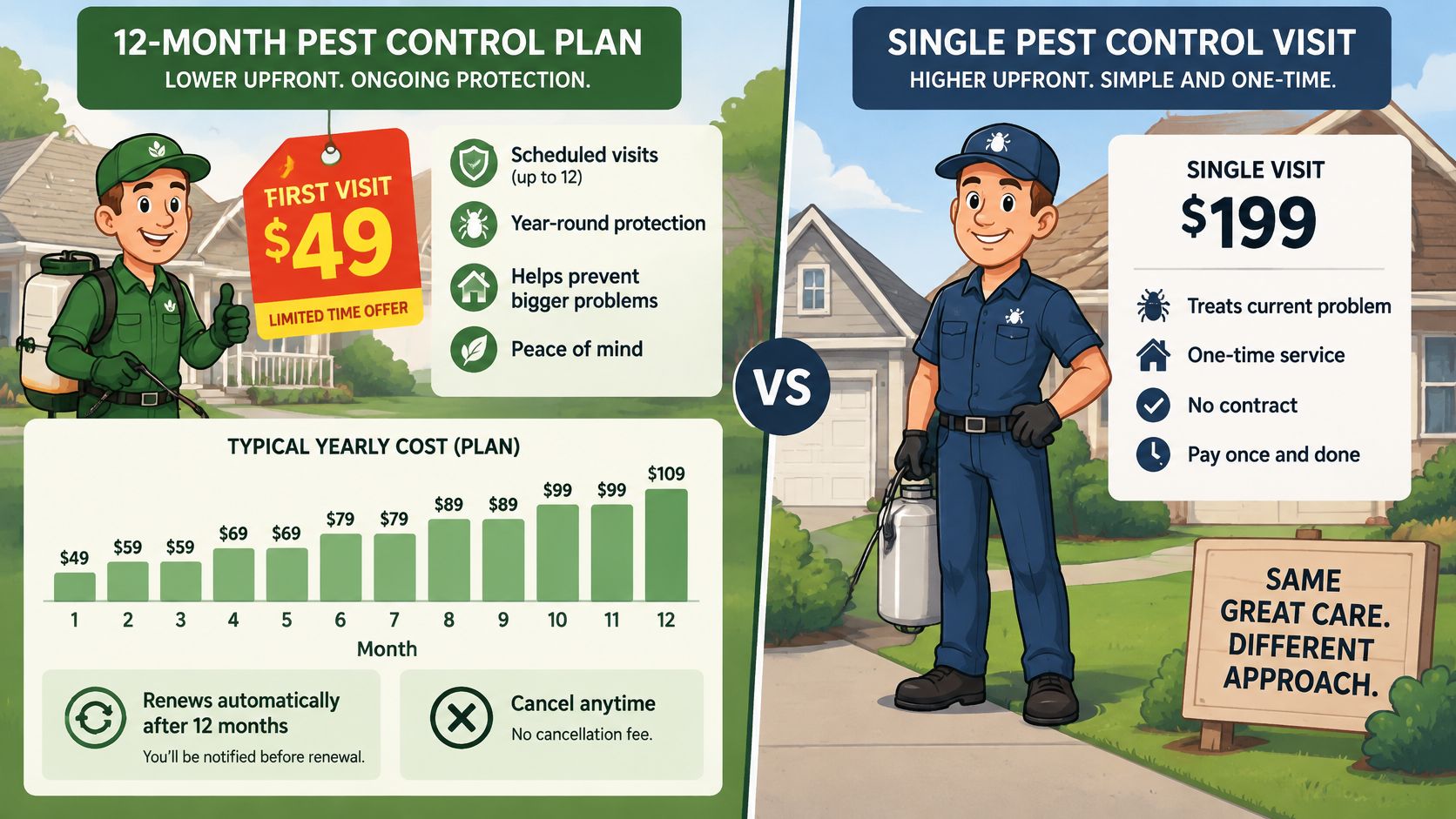
Better Business Bureau complaint records describe customers billed monthly for quarterly or bi-monthly visits, charged early-termination fees after discounted initial treatments, or billed for services that were not clearly disclosed in the agreement. A lower monthly price can cost more than a higher one-time visit when a 12-month commitment or a discounted first treatment is tied to finishing the term.
Walk the agreement in the order the customer meets it
The Maryland Department of Agriculture consumer page tells consumers to obtain a written service agreement, determine whether it automatically renews each year, request annual written confirmation when renewal applies, check cancellation penalties, and submit cancellation in writing rather than by telephone. Those same items belong on the operator's worksheet before the quote goes out.
| Term | What to confirm | Why it matters |
|---|---|---|
| Initial fee | Amount charged for the first visit | A discounted start can hide the later price |
| Recurring charge | Amount and billing period | Monthly billing for quarterly visits is a common dispute |
| Visits per year | Number of scheduled visits in the term | Sets the true cost per visit |
| Included retreatments | Which return visits are covered | Unpriced retreatments become unpaid labor |
| Automatic renewal | Whether the agreement renews each year | Renewal can start without a new signature |
| Cancellation notice | Notice period and the form it must take | Telephone-only cancellation can fail |
| Cancellation fee | Charge for ending early | Can exceed the savings from a discounted first visit |
| Taxes and add-ons | Charges outside the recurring price | Adds to the amount collected each period |
| First-year total | All charges across the first twelve months | The number to compare between plans |
On the operator side, state service frequency and payment frequency as separate lines. Record how many retreatments are included. Show the remaining contract balance before a cancellation is accepted. Compare plans on the first-year total, not the monthly figure.
Invoicing and Software Costs
Software is a line in overhead, the same bucket as insurance and office cost, divided across billable visits. It is not a surprise expense after the route is priced. For pest work, GorillaDesk fits recurring quarterly plans. Housecall Pro fits small to mid-size crews. Jobber fits growing crews that need scheduling and invoicing together. ServiceM8 fits mobile crews that work from job records on the phone.
| Vendor | Fit for a pest operator |
|---|---|
| GorillaDesk | Recurring quarterly plans; confirm features on its own site |
| Housecall Pro | Small to mid-size crews; confirm recurring billing on its own site |
| Jobber | Growing crews with scheduling and invoicing needs; confirm plan limits on its own site |
| ServiceM8 | Mobile crews working from job records; confirm payment fees on its own site |
This guide does not print a plan name or a monthly dollar amount for those four products. A price only belongs in a quote file when it is copied from that vendor's own pricing page, with the date the page was read written as Month D, YYYY. A comparison write-up, a directory, or a review roundup is not that page. If the pricing page shows no figure, write that down instead of guessing. A one-truck operator should ask for the lowest seat count that still includes recurring billing, rather than a plan built for a large office.
Fees and the invoice that matches the quote
Card and ACH fees belong in the margin math because a percentage taken on each visit never reaches the bank. Read the rate on the vendor's own payments page, including any surcharge the customer can be asked to pay. Do not copy a processing rate from a review site.
The invoice should repeat the quote. Service frequency, payment schedule, add-ons, and any compliance line stay visible so a quarterly service billed monthly is not a surprise.
On a demo, ask three things and get the answers in writing. Which plan includes recurring billing for quarterly visits? What is the card and ACH processing rate? Does the price change when a technician is added?
Set Your Local Price and Confirm It in Writing
There is no single national price for pest control in this guide. A local range comes from the operator's own full cost plus any local figure a provider or a government page publishes, with the source and the date that page was read. Roundup and directory averages stay out.
- Run the worked quote for the three most common jobs, using each job's minutes and miles.
- Record full cost per visit and the margin needed for callbacks and slow months.
- Collect local comparisons only from providers that publish prices, note the source and read date, and label any figure that cannot be cited as unverified.
- Set the visit price at or above full cost plus margin, then compare it with that local range. If it sits above the range, say why, such as inspection quality, documentation, or response time.
- Write the visit price, add-ons, renewal terms, and cancellation terms into the quote.
- Confirm those terms with the customer in writing before the first visit.
- Review the price each quarter against cost per visit and callback rate.
The operator should leave this with one visit price, one plan price, and a set review date on the calendar.
Open last quarter's ant, general pest, and termite quotes and rerun the nine-step build with actual minutes and miles. Put the first-year total, not the monthly teaser, on the next agreement before it goes to the customer.