Jobber and most peer pricing pages do not publish a card rate or an ACH rate. On $40,000 taken on cards in a month, 0.4 of a percentage point is $160, which can outweigh the gap between two software plans.
An owner of a small HVAC, plumbing, or cleaning company often opens the bank deposit and the software invoice on the same afternoon. The subscription looks tidy. The card fees do not. A replacement deposit, a stack of service calls, and a few text-to-pay links can each price differently, and the statement rarely names which layer produced which dollar. Field service software payment processing fees sit in that gap between the plan price and the money that lands.
The practical job is to separate those layers before anyone picks a platform. A missing rate on a pricing page isn't a bargain. It's a question for the demo, and it should be answered in writing.
Published Card and ACH Rates by Platform
An owner comparing Jobber, Housecall Pro, ServiceTitan, Workiz, ServiceM8, GorillaDesk, Thryv, and Contractor Foreman should check each platform's current pricing and payments terms for card rates, ACH rates, and additional processor fees. Published details can vary, so compare only figures stated for the same payment method and fee type.
What each platform publishes for card and ACH
| Vendor | Card rate | ACH or bank rate | Additional processor fee |
|---|---|---|---|
| Jobber | Check current pricing and payments terms | Check current pricing and payments terms | Check current pricing and payments terms |
| Housecall Pro | Check current pricing and payments terms | Check current pricing and payments terms | Check current pricing and payments terms |
| ServiceTitan | Check current pricing and payments terms | Check current pricing and payments terms | Check current pricing and payments terms |
| Workiz | Check current pricing and payments terms | Check current pricing and payments terms | Check current pricing and payments terms |
| ServiceM8 | Check current pricing and payments terms | Check current pricing and payments terms | Check current pricing and payments terms |
| GorillaDesk | Check current pricing and payments terms | Check current pricing and payments terms | Check current pricing and payments terms |
| Thryv | Check current pricing and payments terms | Check current pricing and payments terms | Check current pricing and payments terms |
| Contractor Foreman | Check current pricing and payments terms | Check current pricing and payments terms | Check current pricing and payments terms |
A useful comparison needs more than a percentage. For cards, ask whether chip, tap, keyed entry, stored cards, and payment links have the same price, and whether the quote includes a per-transaction charge. For ACH, ask whether the fee is a percentage, a flat amount, a cap, or a combination, and what a returned debit costs. Check separately for gateway, tokenization, monthly minimum, or platform add-on fees.
When a published rate is available, compare it with the written offer. If it is not, request the figures in writing before comparing plans. Even a small rate difference can change the monthly cost: at $40,000 in card volume, 0.4 percentage point equals $160.
The Layers Inside a Quoted Rate
A quoted card rate is a stack, not a feature toggle inside the scheduling app. Money moves outward from the bank that issued the customer's card, and each stop can add a charge.
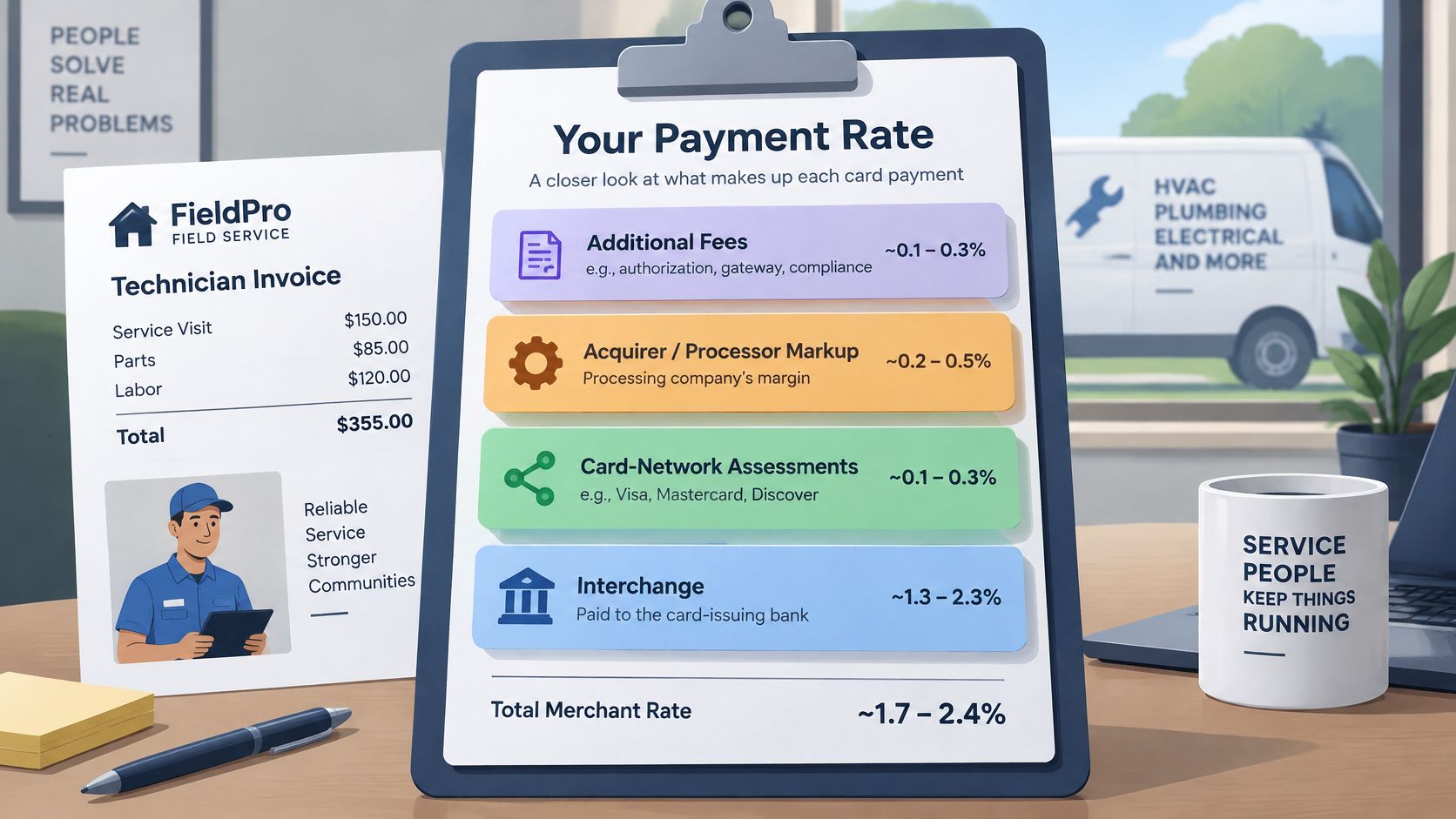
The Federal Reserve states that average U.S. credit-card processing costs generally range from 1.5% to 3% of the transaction amount. Those costs can include interchange paid to the issuing bank, card-network assessments, acquiring-bank charges, payment-gateway fees, and processor fees. Interchange alone may represent about 70% to 90% of the total.
What each layer does
Interchange is the largest piece and it goes to the bank that issued the card. Rewards cards and riskier ways of taking the card usually cost more than a plain debit tap.
Network assessments are the card brand's own dues and fees, separate from interchange.
Acquirer or processor markup is what the company that settles the deposit keeps.
Gateway or tokenization can be a per-transaction or monthly line for storing a card or sending a pay link.
Platform surcharge is anything the field service vendor adds on top of the processor.
On a $1,000 HVAC replacement deposit, plumbing invoice, or landscaping payment, that 1.5% to 3% band is about $15 to $30 before any software subscription, chargeback fee, or monthly account fee. On $100,000 of card volume in a year, the same band is about $1,500 to $3,000. A monthly plan does not reveal this cost. The rate can change by card type, by keyed entry versus chip or tap, and by a text-to-pay link or portal payment versus a jobsite tap.
The headline percent is a merchant discount price, not a single network fee.
That is why two "2.9%" quotes can still produce different deposits. The worksheet in the next section is how an owner turns a blended quote into a cost per ticket.
True Cost on Real Job Tickets
A $150 service call and a $1,000 replacement deposit can face the same quoted card rate, yet the fixed transaction fee takes a bigger share of the smaller ticket. To see what the shop pays, start with three months of deposits. Split settled volume into card-present and card-not-present, then into credit and debit. Add refunds, chargebacks, gateway charges, platform charges, and any monthly processor fee. Divide total payment expense by settled volume to find the effective rate.
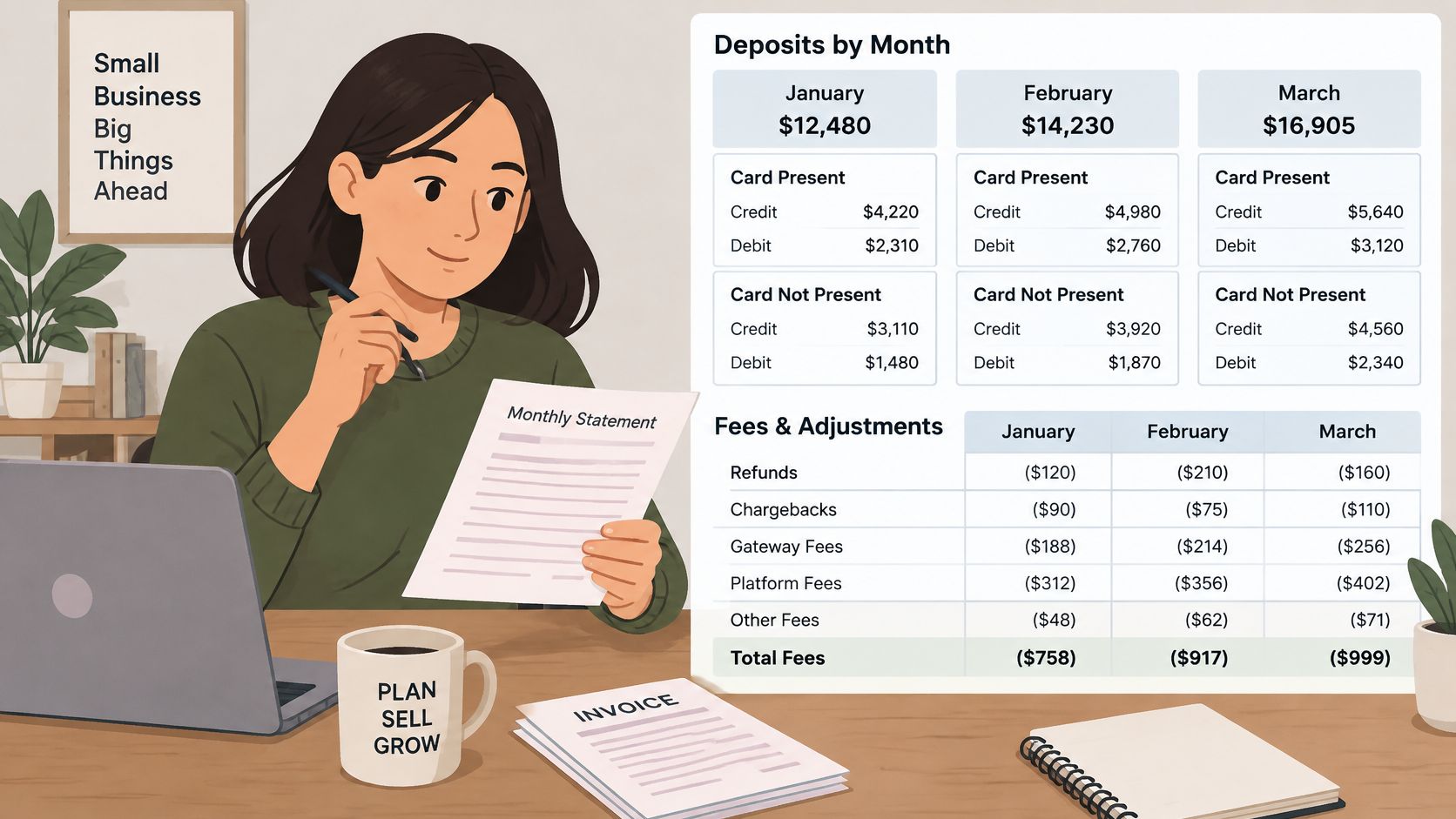
Worked card cost by ticket size
Consider two common quotes: 2.6% plus $0.30 and 2.9% plus $0.30. The percentage difference is three-tenths of a point, while the fixed fee has a larger effect on a small ticket.
| Ticket | 2.6% plus $0.30 | 2.9% plus $0.30 | Gap |
|---|---|---|---|
| $150 service call | $4.20 | $4.65 | $0.45 |
| $1,000 replacement deposit | $26.30 | $29.30 | $3.00 |
On the $150 call, the $4.20 fee equals 2.8% of the ticket, not 2.6%. The $0.30 fixed fee alone adds 0.2 percentage points to the effective cost. On the $1,000 deposit, that same $0.30 is a much smaller share, and the $3 gap comes from the three-tenths-of-a-point rate difference.
For $40,000 in monthly card volume, a 0.4-point rate difference costs $160, before per-transaction fees. Since many field service platforms do not publish a card or bank rate, compare the rates they do publish, then price the gap. Check each vendor's pricing page, and treat a missing processing rate as unknown, not zero.
Why a cheap percent still loses
The Federal Reserve's Regulation II page says the cap on interchange received by covered large debit-card issuers is 21 cents plus 0.05% of the transaction value, with a possible 1-cent fraud-prevention adjustment. Issuers below the $10 billion asset threshold are exempt, so debit costs can differ by issuer.
Refunds and chargebacks can add fees of their own. A lower percentage may cost more overall when per-transaction, payout, or failed-payment charges are added.
Practical rule: Ask for twelve months of sample scenarios in writing, showing the percentage, per-transaction fee, gateway fee, platform surcharge, chargeback fee, and any monthly minimum.
Price those scenarios against the shop's mix of $150 calls, recurring invoices, deposits, and same-day field payments. Compare the resulting costs with ACH and manual bank transfers, using net cash rather than the advertised percentage.
Debit and ACH Versus Credit Cards
A $150 service call paid by debit and a $1,500 progress invoice paid by ACH do not create the same fee pattern as a credit-card payment. Debit and ACH are separate payment rails, not discounts on a credit-card rate. Compare each by the amount left after fees, returns, and the wait for usable funds.
The Federal Reserve's debit interchange series shows that interchange on covered debit transactions has averaged in the low-20-cent range per transaction in recent years. In 2024, exempt transactions averaged $0.51, more than double the covered amount. The Fed's 2024 network data put covered Visa debit at about $0.22 per transaction and Mastercard at about $0.24, near 0.44% and 0.49%.
Those numbers cover interchange only. Network, acquiring, gateway, and processor charges can still apply, so the $0.23 figure cannot establish a vendor's all-in rate.
A month of small debit tickets
Suppose a contractor collects 500 covered debit payments in a month. At $0.23 of interchange per payment, that line alone totals about $115, before the other fee layers. If the processor also charges $0.30 per payment, those 500 charges total $150, more than the $115 interchange line.
That arithmetic explains why small-ticket routes can carry a noticeable fixed-fee stack. A percentage may look low in a sales deck, while per-payment charges add up across lawn, cleaning, or pest stops.
Where ACH fits, and where it doesn't
ACH can suit larger invoices, maintenance plans, deposits, and progress bills when a flat or capped charge costs less than a percentage as the ticket grows. The Federal Reserve's 2024 priced-services release said commercial ACH services were expected to recover 103% of operating, imputed, and capital-related costs, with an estimated average price increase of 1.8% on established mature services. Those wholesale prices do not set the rate inside a field service platform. A software offer may instead include a percentage, flat charge, cap, return fee, or separate platform line.
A job marked paid may still be waiting on final funds. Incorrect account details or an unauthorized debit can reopen the invoice and require office follow-up.
Before enabling ACH, get these terms in writing:
- Maximums: the largest debit the platform will send and any daily cap.
- Timing: when the job can be treated as paid and when the bank will no longer reverse it.
- Returns: the fee, who monitors returned payments, and how the invoice reopens.
- Recurring changes: whether a new amount or schedule requires fresh customer authorization.
Compare each rail by net collected cash: fees, expected return losses, staff time, and the cost of waiting until the funds are usable.
Passing Fees to the Customer
Passing the fee to the customer is a compliance choice, not a switch in settings. Visa's merchant surcharge guidance says surcharges generally apply only to credit cards, not debit or prepaid, and are limited to the merchant discount rate or 3%, whichever is lower. The merchant must notify the acquirer ahead of time, show the fee at the point of entry and at the sale, and itemize it on the receipt.
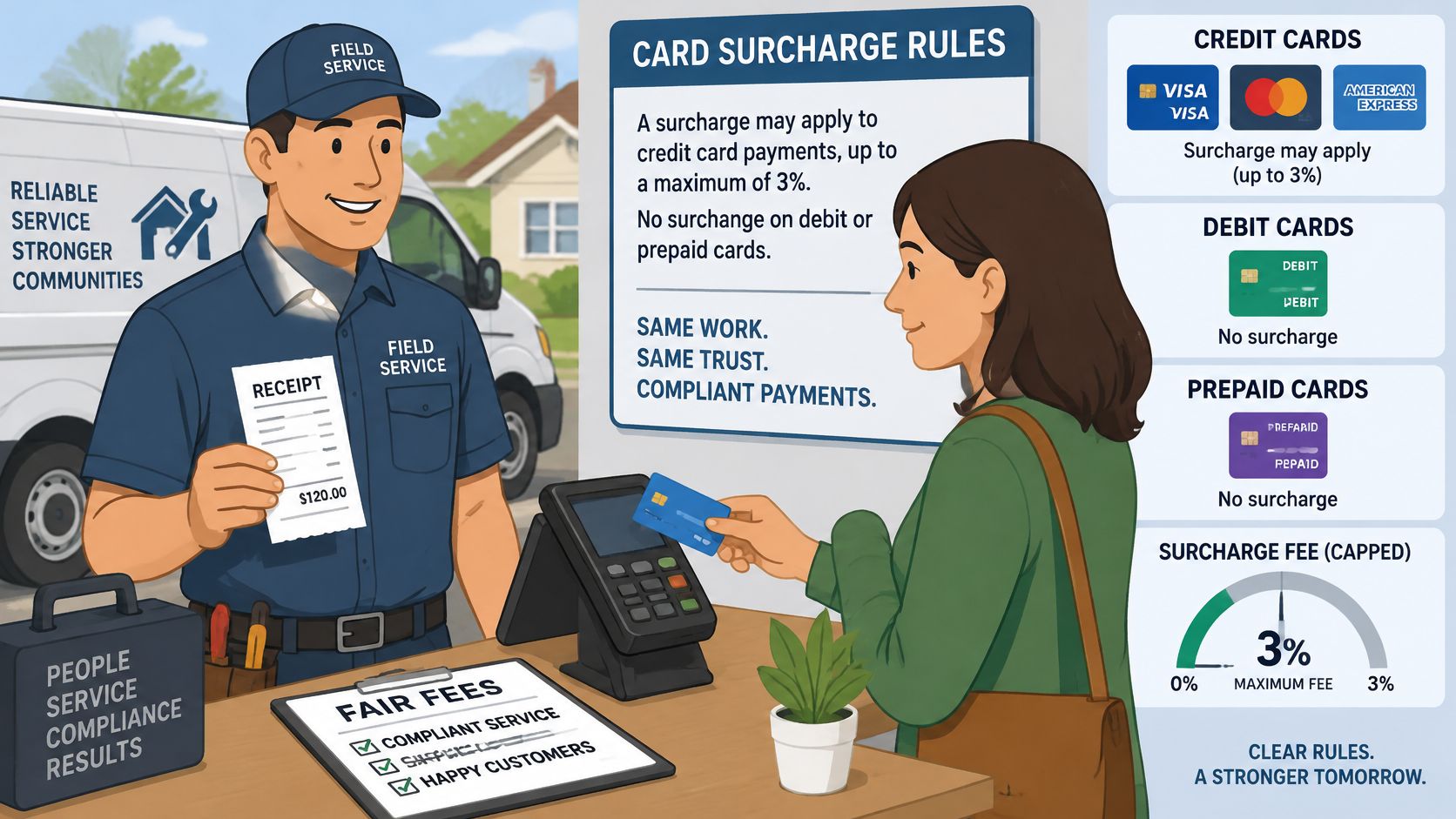
Mastercard's surcharge rules allow either a brand-level surcharge on all Mastercard credit cards or a product-level surcharge on one credit product. The amount has to be clear before the charge, and the dollars have to appear on the receipt.
The field-work test
A quote approval on a phone, a card stored for a seasonal plan, and a texted invoice all have to show the fee before authorization. A counter sign does not cover a payment link the customer opens in a driveway. A platform that says customers can pay the processing fee, but does not say it can tell debit from credit, or brand-level from product-level, leaves the rule unfinished.
A short decision path
Absorb the cost on small tickets when a surprise fee loses the job. A few dollars on a $150 call is often cheaper than a dispute and a one-star review.
Offer ACH on large invoices and deposits, where a flat or capped bank fee beats a credit percent and a surcharge argument.
Use a cash-discount program only if the software posts the cash price as the listed price and does not surcharge debit.
Surcharge credit only after the state rule and the processor both allow it, the software identifies the card correctly, and the receipt itemizes the fee.
A disputed surcharge creates the customer fight the cheap rate was meant to avoid. Fee recovery can shrink the processing line and still raise the cost of keeping the account.
Contract Lines and Fit by Crew
The signed rate is only one line on the statement. A blended rate can include premium rewards cards and card-not-present payments, such as deposits entered through a link. Before a one-to-20-person shop turns processing on, the written offer should show whether keyed, stored-card, and portal payments cost more than chip or tap payments.
Visa's surcharge considerations state that a surcharge cannot exceed the merchant's cost of acceptance. A headline software rate does not, by itself, show whether a customer-facing fee is allowed or calculated correctly. Owners should request the effective-cost math for card-not-present invoices, deposits, recurring charges, refunds, and ACH, including any fees beyond the published rate.
Lines that change the winner
Check monthly minimums, account or PCI fees, instant payouts, failed-payment fees, refund fees, and chargeback fees. These are separate fee layers: a low processing percentage plus several account charges can cost more than a higher percentage that includes them.
If a vendor offers cost-plus or interchange-plus pricing, request a sample statement that separates interchange, dues, and markup. If the vendor will not itemize those amounts, compare the offer as a blended rate rather than treating “at cost” as a discount.
For trial length, seat or user limits, annual billing, and cancellation, use each vendor's own terms page when comparing offers. Ask what happens to customer cards, invoice history, and export files if the shop leaves.
Who should weigh which quote
Solo cleaners, lawn routes, and handymen should compare fixed fees with the processing rate. On dozens of small tickets, a thirty-cent fee can move the monthly total more than a plan-tier upgrade.
HVAC and plumbing crews taking large deposits should confirm the ACH terms first: caps, timing, and return handling. On a four-figure deposit, a percentage fee can outweigh the difference between subscriptions.
Jobber may suit crews that want scheduling and invoicing in one place, provided the payment terms are quoted in writing rather than assumed from the plan page. Housecall Pro offers a comparison point: ask for its card, ACH, and add-on fees in writing too.
ServiceTitan may fit a larger office if its processing terms are as clear as its scheduling terms. For a smaller crew, compare GorillaDesk or ServiceM8 using the fees shown on their own pages or in a written offer tied to those pages. Ask Workiz, Thryv, and Contractor Foreman the same questions. A dispatch screen does not show what a deposit will cost to process.
When two written quotes differ by only a few dollars on a three-month worksheet, prefer the one that itemizes the statement and lets the shop leave with its customer data.
Pull the last three months of card and bank deposits, then split them as the worksheet does. Send Jobber, Housecall Pro, and one smaller-crew vendor the same twelve ticket scenarios. Before signing, get each reply on one page, listing the percentage, per-transaction cents, ACH, refunds, chargebacks, and any monthly minimum.