The job is finished, the equipment is loaded, and the customer seemed satisfied. Then the invoice comes back with a question about the extra work, a request to remove materials, or a reminder that the property manager never approved the final amount. The contractor has completed the service but still has to prove what the customer owes.
Learning how to invoice as a contractor means connecting the bill to the approved scope, the job record, and the payment agreement. A useful invoice doesn't just show a balance. It gives the customer enough information to verify the charge and pay without another round of questions.
Why an Invoice Is a Payment Control Document
Consider a hypothetical pressure-washing job. The homeowner approves the driveway cleaning, then asks the technician to include the patio while the equipment is already running. The technician completes both areas, but nobody records the added price.
When the final invoice arrives, the homeowner remembers the request differently. Perhaps the patio seemed included, or the added charge seems higher than expected. The contractor now has a scope dispute, not just an overdue bill.
A better-looking invoice won't settle that disagreement. The missing document is the approval connecting the extra work to its price.
Follow the authorization through the job
Treat the invoice as the last document in a connected record:
- The estimate establishes the agreement. It identifies included work, exclusions, the pricing basis, and payment expectations.
- The job record establishes delivery. Technician notes, material records, and completion photos explain what happened.
- The approval establishes acceptance. A signed change order or recorded customer authorization supports any departure from the original scope.
The invoice summarizes that record rather than reconstructing it from memory. For example, a patio-cleaning line should refer to the approved addition instead of appearing as an unexplained increase.
Practical rule: Every billed charge should have a clear path back to an agreed price, an authorized change, or a documented pricing method.
Decide who finances the work
Invoicing also involves a credit decision before the first visit. If the contractor purchases materials, pays helpers, and waits until final completion to request payment, the business finances those costs until the customer pays.
That arrangement may be acceptable for a reliable commercial account. It may be unsuitable for an unfamiliar customer ordering material-heavy work. The decision belongs in the estimate and service agreement, not in a tense conversation after completion.
Clear records can't guarantee payment, and a customer can still challenge properly documented work. They do give the contractor a coherent explanation of the balance. Professional invoicing starts with that explanation, not with a logo.
Required Invoice Elements Every Customer Expects
A customer should be able to identify the contractor, recognize the property, match the charges to the work, and find the payment instructions without searching through old messages.
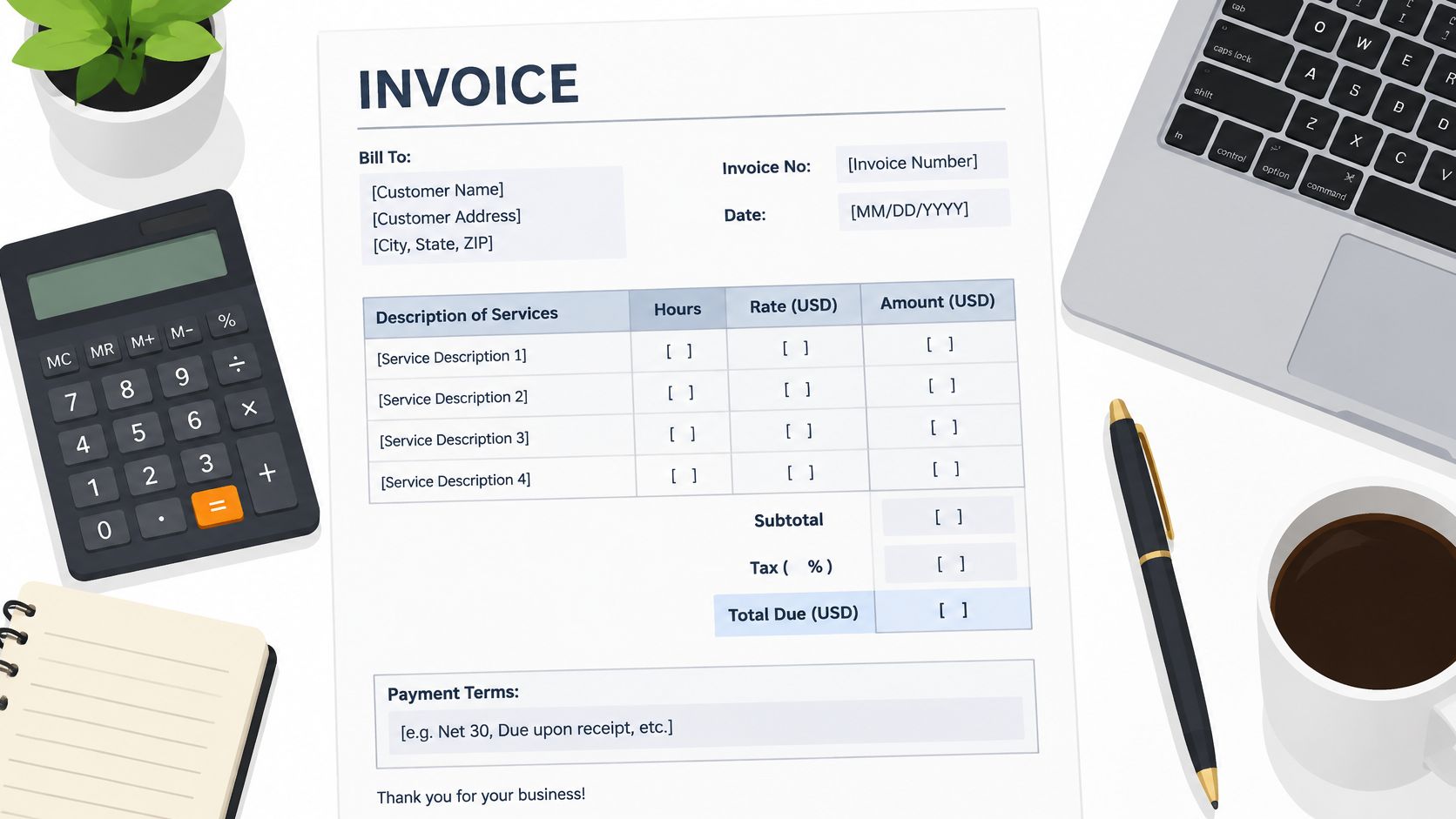
U.S. federal small-business guidance on proper invoices identifies the core fields: invoice date, vendor name and address, an invoice or account identifier, contract number or delivery authorization, work description, price and quantity, and payment terms. Those federal requirements offer a useful baseline, not a universal statement of every residential customer's legal requirements.
Put identification before the charges
Start with the contractor's legal business name, business address, and billing contact. If the customer knows a trading name, display it alongside the legal payee so the invoice and payment recipient don't appear unrelated.
Next, show a unique invoice number, the issue date, and the service date or billing period. Give the job its own reference rather than relying on the customer's name alone. A landlord or commercial customer may have several properties under the same account.
Include both the bill-to customer and the service address. For commercial work, confirm the legal billing entity, purchase-order reference, accounts-payable destination, and required approval attachments before submission.
Describe the work at the agreed level of detail
Itemization should explain the price without changing the pricing agreement. Time-and-materials work needs hours, rates, quantities, and unit prices. A flat-rate service should retain its agreed package description rather than acquire invented hourly allocations after completion.
The following adaptable example uses descriptive placeholders instead of fictional charges.
Residential pressure-washing invoice template
| Field | Sample wording or entry |
|---|---|
| Contractor | [Legal business name], [business address], [billing contact] |
| Bill to | [Homeowner name and billing address] |
| Service location | [Property address] |
| Invoice reference | [Unique invoice identifier] |
| Dates | [Issue date] and [service date] |
| Approved scope | Driveway pressure washing under [approved estimate reference] |
| Labor or service | Driveway cleaning, [agreed quantity or service unit], [agreed price] |
| Materials | [Separately billable materials, quantity, unit price, and amount] |
| Approved addition | Patio cleaning under [change-order reference] |
| Calculation | [Subtotal], [applicable tax], less [deposit or prior payment] |
| Amount due | [Remaining balance] |
| Payment | [Exact due date], [accepted methods], [payment instructions or link] |
| Questions | [Contact for billing questions or reported defects] |
For the patio addition, attach the actual approval rather than merely labeling it approved. Evidence matters more than the label.
Finish with a prominent balance and an exact due date. Keep the original invoice total, prior payments, and remaining balance distinct so a customer doesn't mistake the full job value for a second request to pay an existing deposit.
Deposits, Milestones and Progress Billing Terms
The billing structure should match how the contractor earns the money and incurs the costs. A completed cleaning visit, an uncertain plumbing repair, and a staged painting project shouldn't automatically use the same payment arrangement.
The practical trade-off is straightforward: simpler billing requires less administration, while staged billing gives the contractor more opportunities to recover costs before the entire project ends.
| Billing model | Appropriate use | Deposit or staged-payment approach | Supporting record |
|---|---|---|---|
| Flat rate | A clearly defined visit or finished result | Consider a lawful deposit for advance purchases or committed capacity | Approved scope, exclusions, and completion evidence |
| Time and materials | Emergency repairs or work with uncertain quantities | Agree on any initial payment and an authorization limit before costs expand | Labor entries, material quantities, rates, and approvals |
| Milestone or progress | Multi-day painting, landscaping, or installation work | Tie invoices to defined stages or documented progress | Stage acceptance or supported completion calculations |
| Recurring | Lawn care, pool, pest control, or cleaning routes | Bill after each visit or on an agreed service cycle | Visit history, service exceptions, and approved additions |
Match the payment trigger to something observable
Milestone billing and progress billing aren't interchangeable. A milestone invoice follows a defined event, such as acceptance of a specified installation stage. Progress billing measures work completed against the project's agreed value.
Federal guidance recognizes partial-delivery and progress payments on larger fixed-price contracts and requires accounting that can identify and separate contract costs. That makes cost tracking part of the billing decision, not an optional task after submission.
For a small operator, milestone wording is often easier to explain than a vague percentage-complete estimate. However, a milestone that depends on an unrelated party's schedule can leave completed work waiting for payment. The agreement should address that dependency.
Payment terms should identify the event that starts the clock, not merely state that payment is expected promptly.
Choose invoice delivery, customer approval, or completion deliberately. If approval starts the clock, define the review process and an agreed acceptance window so the invoice doesn't sit indefinitely awaiting an unnamed approver.
Control exposure before accepting more work
The UK government's research on business payment practices illustrates why contractual terms and actual payment behavior should be evaluated separately. Its findings concern UK businesses, but the operational question also matters for a US contractor: how much unpaid work can the business afford to carry?
- Deposits: Establish their purpose, application, and refund treatment in the agreement, subject to applicable rules.
- Change orders: Obtain timestamped authorization before added labor or materials, except emergency work already authorized under the contract.
- Credit limits: Set an unpaid-balance limit and a lawful process for pausing additional non-emergency work.
- Retainage: Identify any withheld balance and its release conditions separately from ordinary payments.
Keep disputed additions identifiable. Combining an unresolved extra with otherwise accepted work makes the account harder to reconcile and the conversation harder to resolve.
Payment Methods, Tax Treatment and Card Fees
The payment method affects what the customer sees at checkout and what the office must reconcile afterward. The best arrangement isn't necessarily the one with the most payment buttons. It's the one the customer can use and the contractor can track accurately.
Avoid promising that any method settles immediately or carries a particular processing cost without confirming the provider's terms. Processing charges, availability, and funding arrangements need to be evaluated for the actual business account.
Separate customer convenience from office workload
| Method | Practical advantage | Control to establish |
|---|---|---|
| Check | Offers a paper payment option | Specify the payee and mailing destination, then track receipt and clearance separately |
| ACH or bank transfer | Provides an electronic alternative to cards | Match the payment reference to the invoice and verify payment status |
| Card through an invoice link | Lets the customer pay from the bill | Confirm processing terms, fee disclosures, and the final checkout total |
| Cash | Allows payment at the property | Issue a receipt and record the payment against the correct invoice |
An invoice marked sent isn't a payment record. Similarly, a customer saying that a transfer was initiated isn't the same as the office confirming receipt. Keep those statuses separate.
Make the final amount visible before payment
The Federal Trade Commission's guidance on mandatory and optional fees states that a mandatory credit-card fee must be included in the total price when credit-card payment is required. When another viable fee-free method is available at the same location or platform, an optional fee must still be disclosed, accurately described, and included in the final amount before payment is requested.
That guidance shouldn't be treated as blanket permission for every contractor surcharge. Applicable federal, state, local, and card-network rules still need review for the business and payment channel.
- Required payment charge: Don't present an unavoidable charge as an optional checkout choice.
- Optional card charge: Identify the available fee-free alternative and clearly label the charge before authorization.
- Processing expense: Keep the provider's actual charge separate from any customer-facing fee in the books.
No processing rate should be assumed from another contractor's account or an old software comparison.
For sales-tax treatment, the contractor should confirm with the relevant tax authority or tax adviser whether the particular service, labor, materials, and job location require collection. A template shouldn't automatically classify every labor line as exempt or every materials line as taxable.
Show the applicable tax treatment clearly enough to review later. When a customer presents exemption documentation, retain it with the job record rather than relying on a note that the customer said no tax was due.
Choosing Invoicing Software and Setting Up Bookkeeping
A basic template can be sufficient when the owner can reliably track approvals, invoices, and payments without duplicate entry. Software becomes worth evaluating when office work repeatedly involves retyping job details, chasing missing approvals, or matching payments across disconnected records.
Jobber and ServiceM8 belong on the evaluation shortlist, but neither should be selected on name recognition alone. The deciding question is whether the proposed setup preserves the complete trail from authorization through payment for the contractor's actual jobs.
Invoicing Software Fit by Trade and Crew Size
The following table gives practical evaluation scenarios, not promises that a particular subscription includes the required functions.
| Vendor | Best fit | Confirm before signing |
|---|---|---|
| ServiceM8 | Evaluate for a solo operator or small repair crew needing a consistent job-to-invoice routine | Device requirements, approval records, invoice attachments, payment options, and accounting transfer |
| Jobber | Evaluate for an owner-operator or small lawn, cleaning, landscaping, or mixed-service crew coordinating repeat work | Recurring-job billing behavior, deposits, reminder controls, staff access, and exports |
| Housecall Pro | Consider alongside the shortlist when an HVAC, plumbing, or electrical office needs broader job coordination | Included workflows, plan restrictions, payment terms, migration requirements, and cancellation provisions |
| GorillaDesk | Consider when a route-based operation needs to demonstrate its recurring service and billing process | Property history, visit exceptions, recurring invoice rules, documentation, and data retrieval |
| Spreadsheet template | A smaller operator with limited billing complexity and disciplined recordkeeping | Formula protection, unique numbering, attachment storage, backups, and manual follow-up responsibility |
A useful demonstration should follow an ordinary job and then an awkward one. The ordinary job proves little if every system can produce a clean final bill. The awkward job reveals whether an approved addition, partial payment, disputed line, and remaining balance stay connected.
Ask for the subscription price, billing period, minimum seats, trial conditions, add-on costs, payment-processing terms, and cancellation arrangements in writing. The contractor should also establish whether invoices, attachments, customer records, and payment history remain exportable after cancellation.
Buying check: An invoice preview isn't enough. The office needs to see the approval record, the payment entry, and the accounting result for the same job.
Set up the books before importing the backlog
Start with customer and property records, then invoice identifiers and job references. Map labor, materials, tax, deposits, refunds, and processing expenses consistently with the accountant's instructions. A bank deposit shouldn't create a second income entry when it represents payment of an existing invoice.
Subcontractor reporting also requires cumulative records. For payments made in 2026, the IRS instructions for Form 1099-NEC generally require reporting qualifying business payments of at least $2,000 to covered nonemployees, including services and related parts or materials; the threshold was $600 before 2026, and backup withholding can trigger reporting below the applicable threshold.
Track the legal payee and total payments across the calendar year rather than evaluating invoices separately. Keep sensitive tax-identification information in the appropriate tax-record workflow, not on a broadly circulated customer invoice.
Compliance Pitfalls and a Final Invoicing Checklist
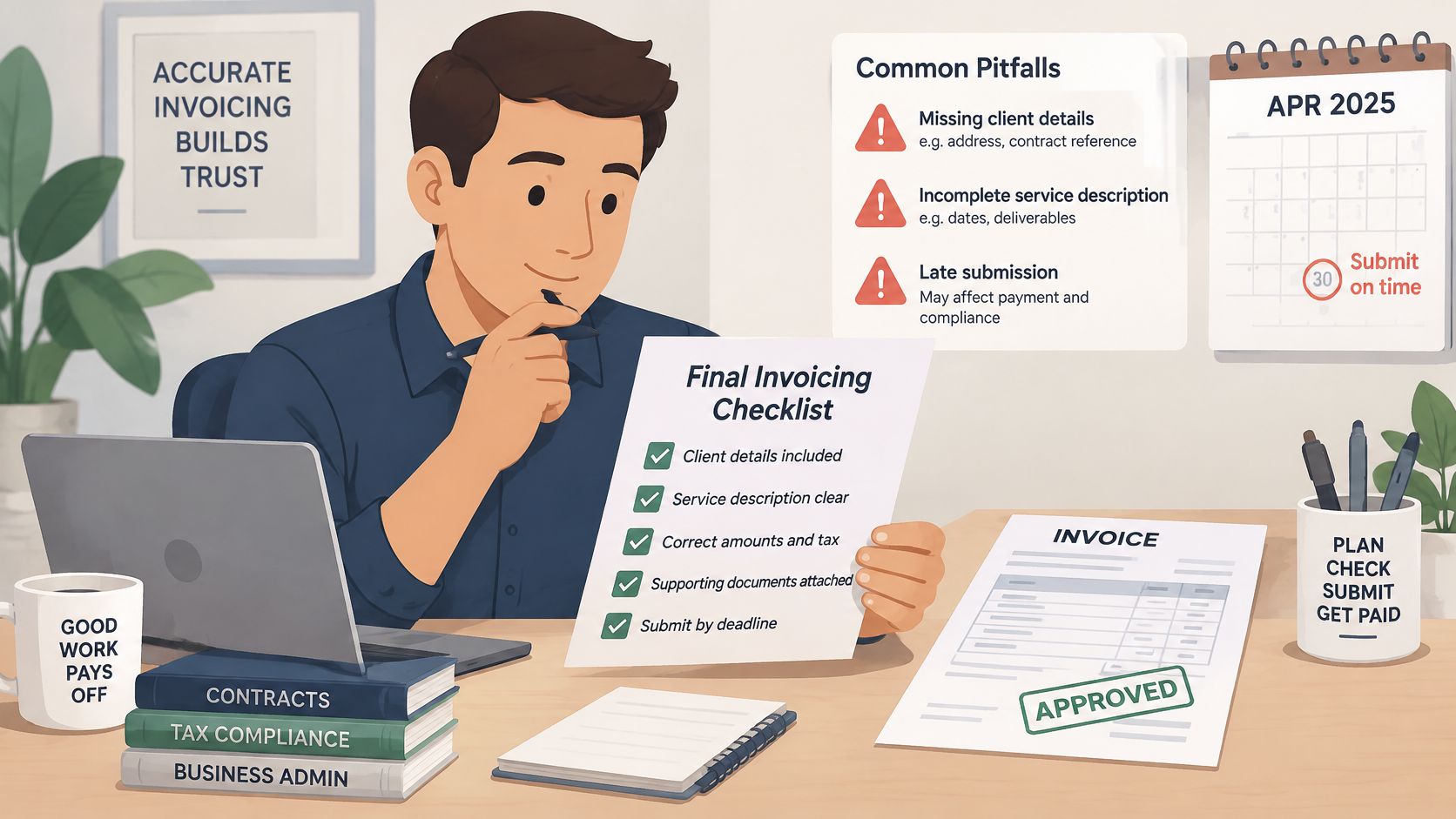
The most frustrating billing problems often begin with an ordinary shortcut. Someone invoices from memory, forgets an approved addition, files a business receipt with personal purchases, or sends the bill without the customer's required purchase-order reference.
The remedy is a repeatable review, not a longer invoice. Each check should answer a specific question about authorization, calculation, delivery, or payment.
Before the invoice leaves the office
Use the job record as the reference point. If a billed amount can't be explained from that record, resolve the missing information before sending.
- Identity and destination: Verify the invoice identifier, legal customer, property, and accounts-payable recipient.
- Scope match: Compare the billed work with the approved estimate and authorized changes.
- Supporting evidence: Attach required approvals, service notes, completion evidence, or customer-specific documents.
- Calculation: Check quantities, unit prices, extensions, applicable tax, and the remaining balance.
- Payment instructions: Confirm the due date, payment recipient, accepted methods, and functioning payment link.
- Contract terms: Include late-payment language only when supported by the agreement and applicable law.
Send the invoice promptly through the customer's required channel and preserve the delivery record. An email to the property contact may not satisfy a commercial customer's separate invoice-submission process.
A correction also needs a record. Preserve the original invoice and document the adjustment rather than changing a previously issued balance without a record.
After sending and after payment
Follow-up should distinguish a missing invoice from a genuine dispute or a late-paying customer. A reminder that repeats the balance won't solve a missing approval attachment.
- Before the due date: Confirm receipt when required and identify unresolved submission problems.
- After the due date: Send the planned reminder, then contact the responsible payer if the balance remains unresolved.
- During a dispute: Record the challenged item, supporting documents, responsible contact, and agreed next action.
- When payment arrives: Apply it to the correct invoice, account for any deposit or partial payment, and reconcile the bank receipt.
- During the weekly review: Check invoice-to-send time, unpaid balances, and customers repeatedly exceeding agreed terms.
Don't invent a universal late-fee rate, deposit rule, or lien deadline. Those remedies require review of the contract, jurisdiction, and type of work before action.
Retain a retrievable job file
The Small Business Administration's recordkeeping guidance notes that invoices, receipts, deposit records, and paid bills support income, deductions, and credits and should be kept as long as needed to substantiate the tax return. A tidy invoice folder alone isn't enough if the supporting receipts and approvals can't be found.
Keep the estimate, authorization, work evidence, invoice, adjustments, and payment record linked to the same job. The useful test is whether someone other than the original technician could explain the balance from the file.
For the next completed job, the owner or office manager should adopt one invoice template, one written set of payment terms, and one weekly tracking habit. Complete the template from the approved job record, submit it through the correct channel, and track the balance through reconciliation. That creates a billing routine the business can repeat without rebuilding the story behind every invoice.